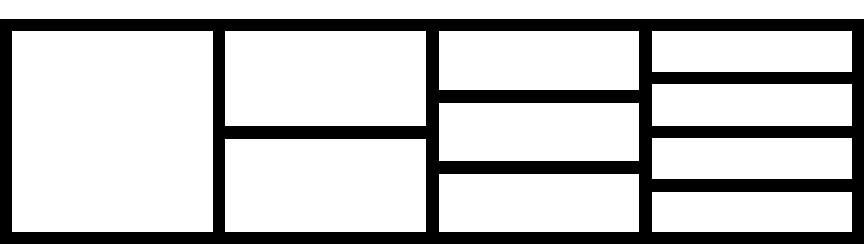

Two kitchens with the same layout, the same fronts and the same budget can feel completely different, and this is usually the decision that separated them. Below the counter, a door and a shelf and a bank of drawers hold roughly the same volume and behave nothing alike. Here is what each one costs, what each one gives back, and the cabinets where the old answer is still the right one.
Design a kitchen →Drawers win below the counter for one physical reason: a base cabinet is 24" (610 mm) deep, which is about the limit of what a person can reach into at floor level, so behind a door the back third becomes storage you have to empty the front to reach. A drawer brings that third out to you. The price is hardware, and it is not small, since every drawer needs runners, a box, a front and its own drilling. Doors still win for tall items, for bins, for the cabinet under the sink, and wherever the budget has to go somewhere else.
Stand in front of an open base cabinet and reach to the back corner. You are bending at the waist, your shoulder is against the frame, and your hand arrives at the back of a cabinet two feet deep. That is the whole case for drawers, and it explains why the change happened in kitchens and not in wardrobes, where cabinets are the same depth but you stand upright in front of them.
A door gives you a clear opening and leaves the storage stationary. A drawer moves the storage. Everything else in this comparison follows from that difference:
A door base is a box, one or two hinges, a front and often a single shelf. A three-drawer base of the same width is three boxes, three pairs of runners, three fronts and the drilling for all of it. The cabinet is the same; everything inside it multiplied.
So the honest framing is that drawers buy access with hardware. Two things follow that are worth planning around:
A page that only argued for drawers would be selling rather than explaining. Doors are the better answer in several ordinary places:
A three-drawer base is usually split with a shallow drawer on top and two deeper ones below. Our line uses 6", 12" and 12", and that is a choice rather than a standard: 5/5/5/8" in four drawers and 15/15"in two are both normal, and our own 30" drawer base uses the pair of fifteens.
Two rules of thumb behind the arrangement:
A detail that alarms people the first time they notice it: there is nothing between the drawers. No shelf, no rail. Each drawer hangs from runners screwed to the cabinet sides and the space between them is air, which is normal, well documented and covered with the evidence in the anatomy guide.
Kitchens are laid out by width: you pick cabinets that add up to your wall. Which is why every width in a proper catalogue exists in both forms, a door version and a drawer version, at 12, 18, 24, 30 and 36 inches. Our own line holds that as an invariant with a test behind it, for a practical reason: if the drawer version of a width is missing, you have to change the width, and changing one width shifts the entire run.
So the sequence that works is to solve the layout first, in widths, and then walk along the run deciding which of those boxes opens by pulling and which by swinging. That decision costs nothing while the kitchen is a drawing and a great deal afterwards.
Turn a door base into a drawer bank in the editor and the boxes, the runners, the fronts and the drilling all rebuild around it, with the price moving as they go. Convert the two cabinets by the cooker and leave the rest, and you can see exactly what that costs.