Drawer slides: roller, ball-bearing, undermount, and none at all
A drawer is a box on a pair of runners, and the runners decide almost everything about how it feels: whether it glides or drags, whether it closes itself softly or slams, whether the whole box comes out or only three quarters of it, and whether you see hardware down the side of the drawer or nothing at all. There are three kinds in general use, plus the oldest option of all: no hardware, wood running on wood. Here is what each one does, what it costs, and where it belongs. Dimensions are in inches with millimetres in brackets; runner lengths read in millimetres, the way the trade sizes them.
The short version: before any of this existed, drawers ran on wooden runners, rails inside the carcass with the drawer sliding straight on them, wood rubbing on wood. It still turns up in fine cabinetmaking and in antique furniture, and it needs no hardware at all. Roller slides are the cheapest runners made, with no soft-close, no adjustment and only partial extension, and they are why a budget chest of drawers feels like a budget chest of drawers. Ball-bearing side-mount runners are a real step up: full extension, integrated soft-close, push-to-open if you want it, but they are bolted to the outside of the drawer box, so you look at a steel rail every time you open it. Undermount slides hide underneath the box: you see bare board, they close softly, and the good ones adjust in three directions after they are fitted. They cost the most. For a kitchen or a walk-in wardrobe, that is the one worth paying for; for a garage or a utility cupboard, it is not.
No slides at all: wood running on wood
The oldest drawer runs on nothing but itself. A rail, the runner, is fixed inside the carcass on each side, the drawer sits on it, and the two timber surfaces slide against each other. A second rail above, the kicker, stops the drawer tipping nose-down as it comes out. There is no hardware anywhere in it, and every drawer made before the twentieth century worked this way.
It is still built today, in two very different places: at the top of the market, in hand-cut bespoke and antique-reproduction furniture where metal runners would look wrong and the joinery is the point; and at the very bottom, in rough casework where a rail costs less than a pair of runners. What it gives you:
Nothing to see and nothing to fail. No mechanism, so no mechanism to wear out or go obsolete. A three-hundred-year-old chest still opens. Spares are a piece of timber.
Friction is the whole mechanism. Wood on wood drags. It is heavier to pull than any runner on this page, it wears a groove over decades of use, and it is traditionally kept sweet with wax or a candle rubbed on the runner. A drawer that has never been waxed sticks.
It moves with the weather. Timber swells in humid air and shrinks in dry, so the same drawer that glides in February can bind in August. This is the complaint people have about old furniture, and it is wood behaving like wood rather than a defect.
No soft-close, no full extension, no adjustment. The drawer comes out until it starts to tip, and stops there. Everything you would tune on a modern runner is instead fixed by how accurately the carcass was made.
It demands real joinery. The fit is planed, not bought. Done well it is beautiful; done badly it is a drawer that racks, rubs and jams, with no adjustment screw to rescue it.
So it is a real choice rather than a relic, but a choice about craft, not about convenience. If you want a kitchen drawer that closes itself softly with a full load of pans in it, this is not the way to get there. We do not build wooden runners: our cabinets are engineered board on metal hardware, and the three runners below are what we fit.
Roller slides: the cheapest thing that works
A roller slide, often called an epoxy slide after its powder-coated white or cream finish, is two pressed-steel channels and a couple of plastic wheels. One wheel at the back of the cabinet member, one at the front of the drawer member, and the box rolls between them. That is the entire mechanism, and it is the reason the thing is cheap: there is almost nothing in it.
What you give up is most of the list:
No soft-close and no damper. The drawer stops when it hits the back, or when you stop it. Roller runners of this class are usually self-closing instead: the last stretch of the channel is inclined, so the drawer rolls itself shut over the final inch and lands with a knock. That is a different thing from soft-close and it does not feel like it.
No adjustment. Nothing on the runner moves after it is screwed down. If the drawer front sits crooked, your options are to unscrew it and try again, or live with it. Every other runner type on this page gives you at least some correction.
Partial extension. Roughly three quarters of the box comes out; the back quarter stays inside the cabinet. In a deep base unit that is the part where things go to be forgotten.
Modest load and a looser feel. Two plastic wheels carry the box, so it rocks slightly side to side and rumbles as it rolls.
None of that makes them useless. Roller slides are dimensionally forgiving, they last for years in light service, and they are what the entire budget flat-pack furniture industry is built on: the chest of drawers, the storage unit, the desk pedestal. When a piece of furniture has to hit a price, this is the runner that gets it there. It is the bottom of the market by design, not by accident.
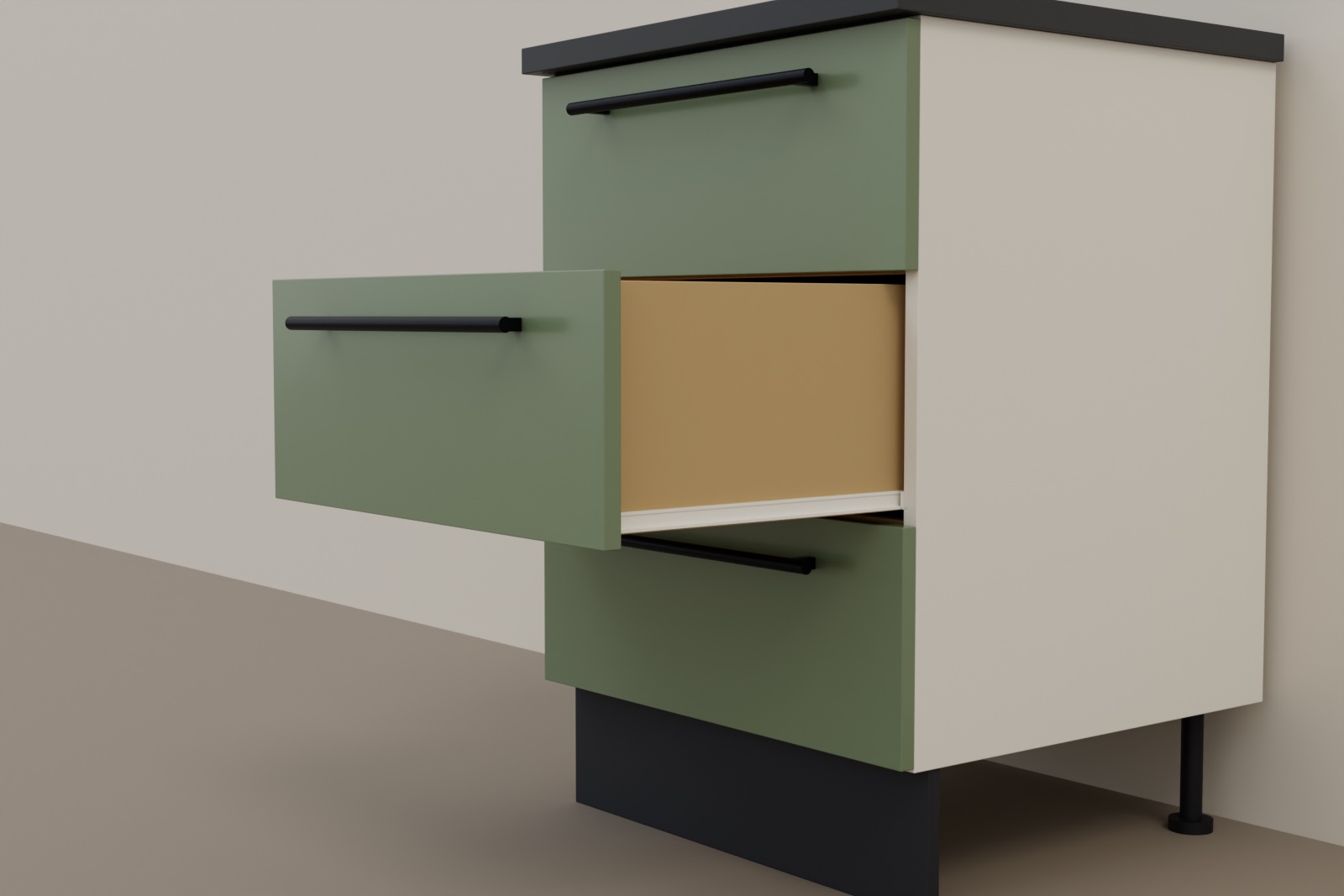
A roller runner: a low epoxy-coated channel along the bottom edge, with a plastic wheel inside it doing the work. Note how much of the box is still in the cabinet. That is partial extension, and it is the norm at this price.
Ball-bearing side-mount: everything works, and you can see it
A side-mount ball-bearing runner is a telescopic steel rail, usually three members riding on caged ball bearings, screwed to the side of the drawer box and to the cabinet wall opposite it. The bearings are why it feels completely different from a roller: smooth, quiet, no rocking, and happy to carry a loaded drawer. Standard duty is around 100 lb (45 kg) per pair.
Functionally it gives you nearly the whole list:
Full extension. The box clears the cabinet front completely, so you can reach the back of the drawer.
Integrated soft-close. The damper is built into the runner and catches the drawer over the last couple of inches. Push-to-open versions exist too, for handleless fronts.
Forgiving to fit. The box is ½" (12.5 mm) narrower than the opening on each side, and the runner does not care much about anything else.
Some height adjustment, on some models. Not the three-way adjustment an undermount gives you, but not nothing either: the Accuride 3832EC carries a cam adjuster on the drawer member with ⅛" (3.2 mm)of total travel, 1/16" up or down, to level a front after it is hung. Plenty of cheaper ball-bearing runners have none at all.
One thing worth clearing up, because it is often stated as a rule: the slide does nothave to sit at the middle of the drawer side. The manufacturers' own spec sheets set the side clearance, the setback from the front and the hole pattern, and say nothing at all about how high up the side the runner goes. Mid-height and down along the bottom edge are both correct installations, and the choice is the maker's. What is fixed is a minimum: Accuride calls for a drawer at least 1‑7/8" (47.6 mm) tall for a runner 1.80" (45.7 mm) high. On a drawer that shallow the rail fills the side and there is no height to choose. Our editor centres the runner on the box; that is our default, not an industry law.
The drawback is visual, and it is the whole reason undermounts exist: the runner is 45 mm of bright steel running down the middle of the drawer side, and you see it every time the drawer is open. On an inset front you may catch it through the reveal even when the drawer is shut. It also collects kitchen grease along its length, and it eats 1" (25 mm) of drawer width overall.
So: excellent hardware, wrong place for it in a room people look at. Side-mount runners belong where function outranks looks: garage storage, a workshop, a utility or laundry cupboard, a server or tool cabinet, the inside of a plant room. Trade shops fit them on commercial joinery for exactly this reason.
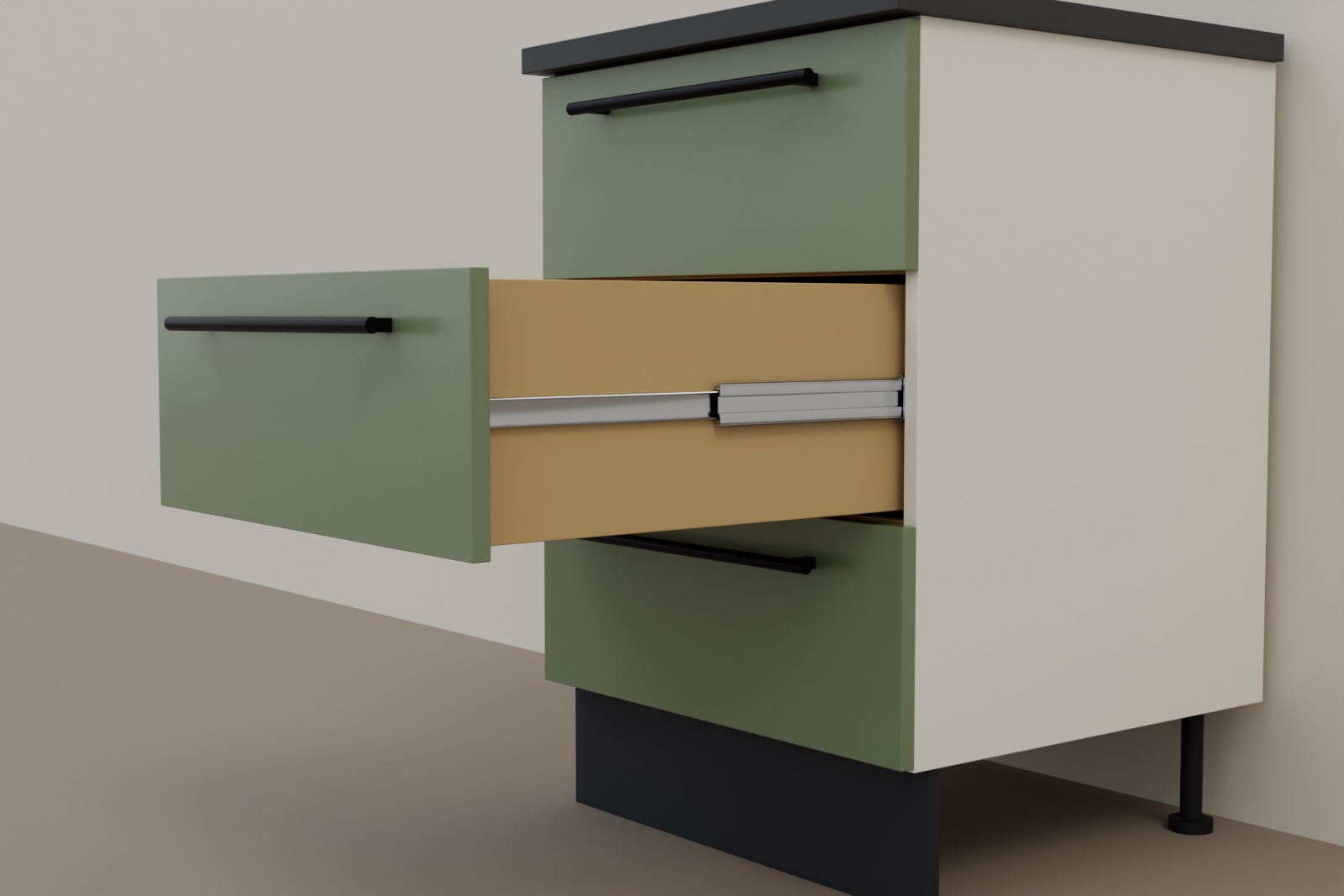
The same drawer on ball-bearing runners. It glides, it closes softly, it comes all the way out, and there is a steel rail down the side of the box that you cannot unsee. The rail here is not a drawing of one: it is Hettich's published KA 5632 profile extruded along the drawer, so the three members telescope where the real ones do.
Undermount: the runner you never see
An undermount slide carries the drawer from below. The runner sits in the cabinet under the box, hooks onto the underside of the drawer bottom and clips to the back, so the sides of the drawer are bare board, with nothing on them at all. Open a drawer on undermounts and you see joinery, not hardware. That is what you are paying for, and on a kitchen or a wardrobe it is worth it.
What comes with it:
Nothing visible. No rail on the side, and nothing to wipe grease off. This is the reason the whole premium market moved to undermounts.
Soft-close as standard, push-to-open available. The damper is built into the runner. On the better lines it is good: the drawer is taken out of your hand and closed for you.
Three-way adjustment, on the models that offer it. Height, side and tilt, adjusted with your fingers after the drawer is hung. It is what makes a run of drawer fronts line up dead flat across a kitchen, and it is the single most useful feature on this page. It is also the thing you pay extra for: the cheaper undermounts give you two directions or none.
A tighter build.Blum's own specification for the TANDEM 563H is exact: with ⅝" (16 mm) drawer sides the box is opening width minus ⅜" (10 mm), only 5 mm a side, with 9/16" (14 mm) of clearance underneath and a rear notch of at least 1‑3/8" (35 mm) for the hooks. The runner is fussier about a square box than a side-mount is, but the adjustment afterwards more than pays that back.
The honest catch beyond price: undermounts eat drawer height, since the mechanism lives under the box, so on a very shallow drawer a side-mount can be the more sensible choice. And front locking clips and rear brackets are usually sold separately from the runner, which is how a headline price quietly grows by $5–15 a drawer.
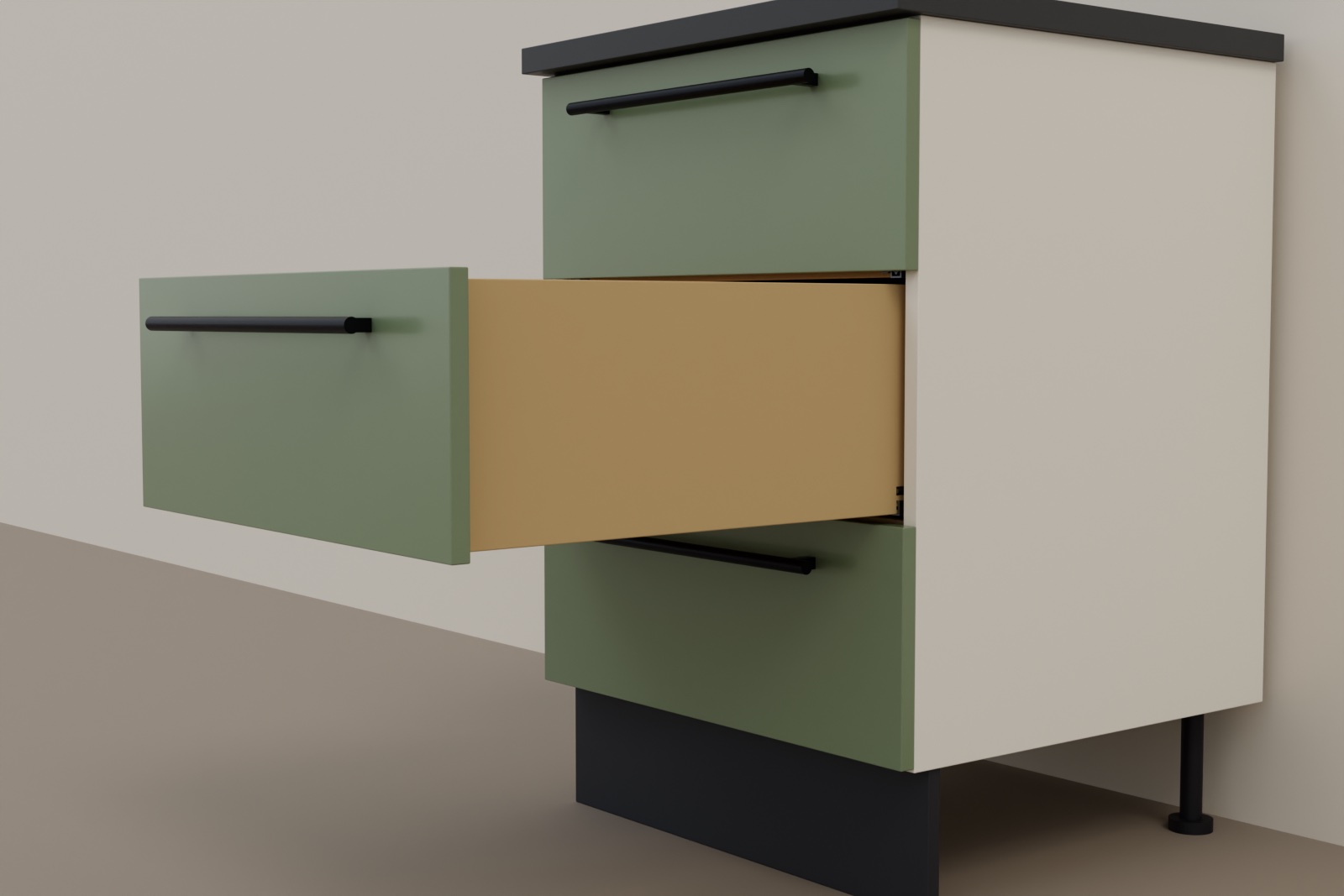
The same drawer again, same camera, on undermounts. The side of the box is empty. That is the entire argument, and no amount of spec sheet makes it as well as this does.
Head to head
The same questions asked of all three. Prices are per drawer, since runners are bought and fitted as a pair, and are retail bands as of July 2026, spanning budget imports up to the branded European lines. Treat them as orientation, not a quote.
None: wooden runners
Roller (epoxy)
Ball-bearing, side-mount
Undermount (concealed)
Typical models
Traditional joinery; no catalogue part
Blum 230M class
GTV 45 mm · Accuride 3832EC · Knape & Vogt 8450FM
Blum TANDEM 562H/563H · Grass Dynapro · Hettich Quadro
Where it mounts
No hardware. The drawer rides on wooden rails in the carcass
Bottom / side of the box, low at the corner
Both sides of the box, mid-height or down at the bottom edge; the specs do not fix the height
Underneath the box, hidden
Extension
Partial. It stops when the drawer tips
Partial. About ¾ of the box comes out
Full. The whole box clears the cabinet
Full. The whole box clears the cabinet
Soft-close
None
None
Yes, integrated
Yes, integrated
Push-to-open
None
None
Yes, on push-to-open versions
Yes, on push-to-open versions
Adjustment
None. The joinery sets it
None
Height only, on models with a cam adjuster: ⅛" (3.2 mm) total on the Accuride 3832EC
Yes: height, side and tilt, tool-free, after fitting
Visible in use
No hardware to see at all
Yes: a white or cream strip along the lower edge
Yes: a 45 mm steel runner along the drawer side
No. The drawer side is bare board
Price per drawer
No part cost. You pay in labour
$5–12
$8–48
$15–60
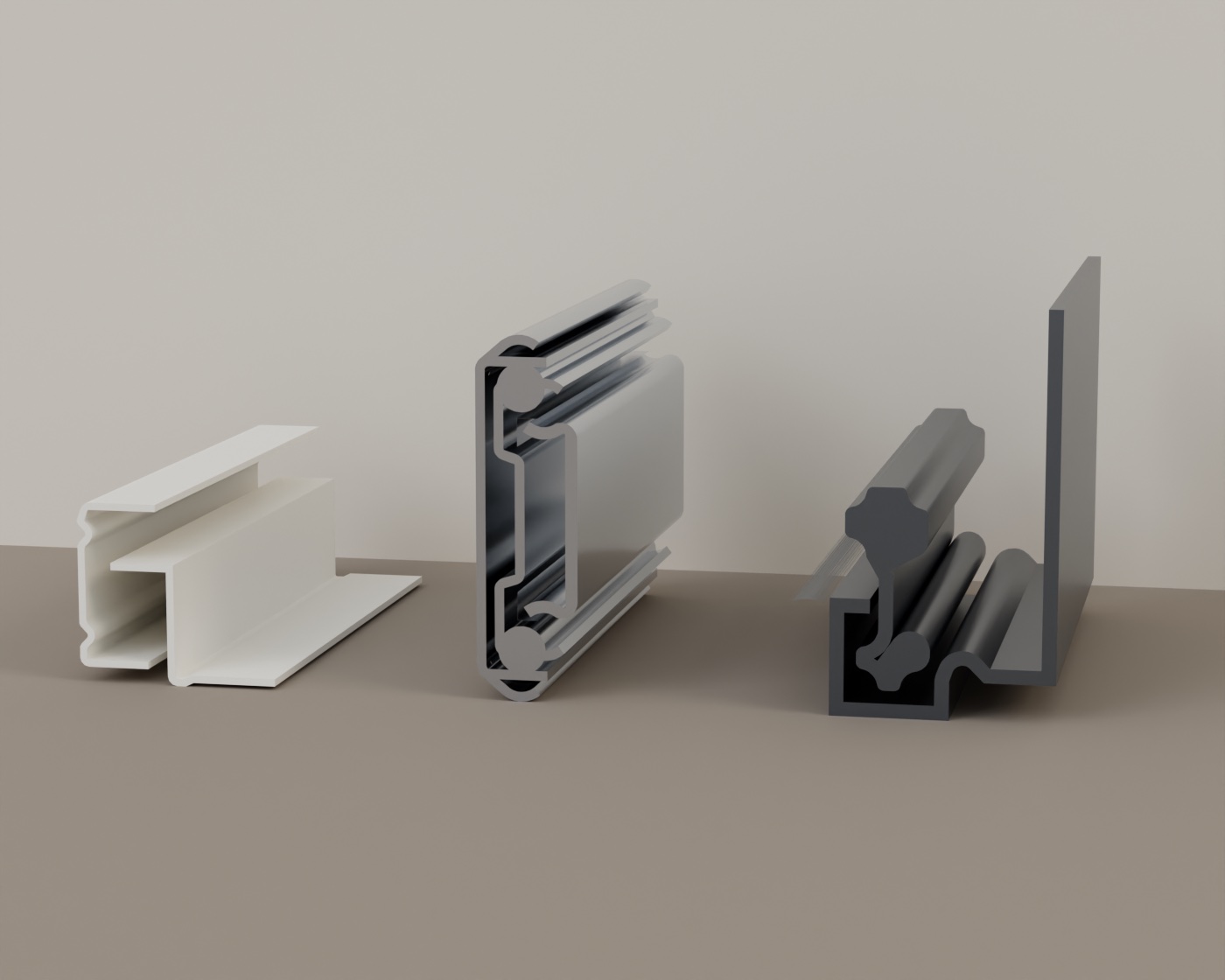
Sections through real hardware, at true relative scale, built from Hettich's published CAD, so these are the actual profiles rather than a drawing of them. Left to right: a roller channel (FR 302), 25.6 × 23 mm; a ball-bearing rail (KA 5632 Silent System), 12.7 mm thin and 45.4 mm tall, three members riding on the ball races formed top and bottom; and an undermount (Quadro V6), 32.3 × 49.8 mm. The ball-bearing is the tall one, and it is tall down the side of your drawer. The undermount is bulkier still, and all of it lives under the box, where you never see it.
What changes in the cut list
Runner choice is not a finishing decision. It changes the drawer box itself. Each type wants a different gap between the box and the cabinet wall, sits at a different height, and comes in a different ladder of lengths that the box depth has to land on. These are the numbers the hardware itself calls for, taken from the manufacturers' published installation specifications:
Roller (epoxy)
Ball-bearing, side-mount
Undermount (concealed)
Lengths offered
250–550 mm (10–22"), 50 mm steps
250–550 mm (10–22"), 50 mm steps
250–550 mm (10–22"), 13 sizes
Box narrower than the opening, per side
13 mm each side
12.5 mm each side
5 mm each side with 16 mm drawer sides (Blum: opening − 10 mm outside, − 42 mm inside)
Runner screw row
16 mm above the cabinet floor
Centred on the box height, our default; the specs leave the height free
37 mm above the cabinet floor (System-32 first row)
Common to all three: a drawer box sitting 14 mm behind the front, by default 16 mm sides and back with a 4 mm bottom captured in a 6 mm groove, though how the box itself is built is a separate choice. Change the runner and the box width, the box depth and the drilling all move with it, which is why this is a decision to make while the cabinet is being drawn, not afterwards.
Can you swap roller slides for ball-bearing ones later?
Usually yes, and it is the single best-value upgrade on a cheap chest of drawers. Both types mount to the side of the box, both are sized in the same length ladder, and both want roughly the same gap: our roller entry asks 13 mm a side, the ball-bearing 12.5 mm. Half a millimetre a side is inside the slack most drawers already have.
But roughly is doing real work in that sentence. The specs are similar, not identical, and three things bite:
Height. A roller runner sits low at the corner (16 mm above the cabinet floor); a ball-bearing runner is centred on the drawer height. New screw holes, in new places, and the old ones are still there.
Width. If the old box was built to a 13 mm gap it will sit 1 mm loose on the new runners. Tolerable, but you will feel it. Built the other way round it will not go in.
Depth. The box has to land on a length the new runner comes in, and a full-extension runner needs the cabinet to be deep enough to swallow it.
Going the other way, retrofitting undermounts onto an existing drawer, is a different proposition and usually not worth it: the box needs a specific width and height, clearance underneath, and a notch cut in the back for the hooks. That is a new drawer box with extra steps.
Which is the real point: the cheap runner is not the expensive part. rebuilding around it later is. Choose the hardware while the cabinet is still a drawing, when moving from one runner to another costs nothing but a click.
So which one
Kitchen, wardrobe, anything in a room you live in: undermount. The drawers are opened many times a day in front of everyone, and the side of the box is in plain view every time. This is where concealed runners with soft-close earn their money, and where the three-way adjustment shows up as fronts that line up.
Garage, workshop, laundry, plant room, deep tool storage: side-mount ball-bearing. Full extension and soft-close for a fraction of the price, and nobody cares that the runner is visible. Paying an undermount premium here is spending money where it does not show.
Wooden runners, where the craft is the point. Period and hand-cut furniture, where visible metal would be wrong and the joinery is what you are buying. Not a way to get a soft-closing kitchen drawer, and not something we build.
Roller slides, only where price is the specification. They work, they are dimensionally forgiving, and they are the cheapest runners made. Know what you are buying: no soft-close, no adjustment, and a quarter of the drawer that never comes out.
Pick the runner, see what it costs
Drawer runners are a choice on your design, not a surprise on an invoice. Switch a cabinet between roller, ball-bearing and concealed undermount and the drawer boxes, the drilling and the price all rebuild around it, so you can see the difference the hardware makes before anything is cut.
Roller (epoxy) slides, side-mount ball-bearing slides and concealed undermount slides. Roller slides are the cheapest: two steel channels and a plastic wheel, partial extension, no soft-close and no adjustment. Side-mount ball-bearing slides run on caged bearings, give full extension and integrated soft-close, but are visible down the side of the drawer box. Undermount slides sit hidden beneath the box, so the drawer sides are bare, and offer soft-close, push-to-open and, on the better models, three-way adjustment. Price rises in that order.
Are undermount slides worth the extra money?
In a kitchen or a walk-in wardrobe, yes. The runner is invisible, so opening a drawer shows joinery rather than a steel rail; the soft-close is better; and models with three-way adjustment let you line a whole run of drawer fronts up flat after they are hung, which is what separates a fitted kitchen from a flat-pack one. In a garage, workshop or laundry cupboard, no: a side-mount ball-bearing runner does the same job functionally for a fraction of the cost, and nobody minds seeing it.
Do roller drawer slides have soft-close?
No. Roller slides in this class are self-closing, not soft-closing: the last stretch of the channel is inclined so the drawer rolls itself shut over the final inch and lands with a knock. There is no damper and no way to add one, and there is no adjustment on the runner either, so if the front sits crooked you unscrew it and try again. That, together with only partial extension, is what you are accepting in exchange for the lowest price on the market.
Why can I see the slides on my drawers?
Because they are side-mount runners. A ball-bearing side-mount slide is a steel rail about 45 mm tall screwed to the outside of the drawer box, so it is in view whenever the drawer is open, and on inset fronts it can be glimpsed through the reveal even when shut. It is how that type mounts rather than a fault or a bad installation. The alternative is an undermount slide, which carries the box from underneath and leaves the sides bare.
Can I replace roller slides with ball-bearing slides?
Usually yes, and it is the best-value upgrade on a cheap chest of drawers, but the specs are similar rather than identical. Both mount to the side of the box and come in the same length ladder, and the required gap differs only slightly: 13 mm a side for roller runners against 12.5 mm for ball-bearing. What does differ is height: a roller runner sits low at the bottom corner while a ball-bearing runner is centred on the drawer, so you will be drilling new holes. The box depth also has to land on a length the new runner comes in. Retrofitting undermounts to an existing drawer is a different matter and rarely worth it, since the box needs a specific width and height, clearance underneath and a notch cut in the back.
How much do drawer slides cost per drawer?
Runners are bought as a pair, one pair per drawer. As of July 2026 the retail bands are roughly $5–12 a pair for roller slides, $8–48 for side-mount ball-bearing with soft-close (budget imports at the bottom, Accuride or Knape & Vogt at the top) and $15–60 for concealed undermounts (generic imports up to Blum and Grass). One thing to watch on undermounts: the front locking clips and rear brackets are often sold separately from the runner, which adds around $5–15 a drawer to a headline price that looked cheaper.
What does three-way adjustment on a drawer slide mean?
It means the drawer front can be moved after the drawer is hung, in three directions, up and down, side to side, and tilted, usually with your fingers and no tools. It matters because a run of drawer fronts across a kitchen only looks right when the gaps between them are even, and no amount of care during assembly gets you there as reliably as adjusting afterwards. It is a feature of the better undermount runners specifically: cheaper undermounts offer fewer directions. Side-mount ball-bearing slides are not always without adjustment, since the Accuride 3832EC has a cam giving an eighth of an inch of height adjustment, but that is one direction rather than three. Roller slides and wooden runners offer none at all.
Do drawer slides have to be mounted in the middle of the drawer side?
No. The manufacturers' spec sheets for side-mount ball-bearing slides set the side clearance (half an inch each side), the setback from the drawer front and the screw hole pattern, and say nothing about how high up the drawer side the runner is fitted. Mounting at mid-height and mounting low along the bottom edge are both correct. There is one hard limit rather than a position: Accuride specifies a minimum drawer height of 1-7/8 inches for a slide 1.80 inches tall, so on a shallow drawer the runner fills the side and there is no choice to make. Note also that 'bottom mount' as a shop term usually means something else entirely, either white epoxy roller slides or concealed undermount slides, rather than a side runner fitted low.
Can a drawer be made without slides at all?
Yes, and it is how every drawer was made before the twentieth century. A wooden rail called a runner is fixed inside the carcass on each side, the drawer rides directly on it, and a second rail above, the kicker, stops it tipping as it comes out. There is no hardware, nothing to wear out and nothing to see, which is why it is still used in hand-cut bespoke and antique-reproduction furniture. The trade-offs are real: wood on wood is heavy to pull and is traditionally waxed to stay sweet, the fit changes with humidity so a drawer can bind in damp weather, and there is no soft-close, no full extension and no adjustment to correct a front. It rewards very accurate joinery and it is a choice about craft rather than convenience. We do not build wooden runners; our cabinets are engineered board on metal hardware.