Drawer box construction: butt joint, connector, dowel, dovetail, and no wooden sides at all
A drawer is a box on a pair of runners. The runners decide how it feels to open; the box decides how long it lasts, how much it holds and what it costs to make. Two questions, two answers, and they are chosen separately: the same concealed runner will carry a stapled hardboard box and a hand-cut maple one. Here are the five ways the box itself gets built, what each does to the cut list, and which one belongs where.
The short version: a screwed butt joint is the cheapest box that is still a drawer: panels screwed together at the corners with the bottom stapled on underneath, and the load hanging on screws driven into the edge of a board. A knock-down connector replaces those screws with a fitting machined from one face, so the box takes apart and goes back together and there is no edge boring at all; that is what we build by default. Glued dowels are what a cabinet shop uses: invisible, very strong, and permanent, because the glue line is the joint. Cut dovetails in solid timberare the strongest wooden corner there is and the one people mean by “proper joinery”. And a metal-sided system box skips the question: the sides are bought steel profiles that are also the runner, so there is no corner to make and only three panels to cut.
First: is the front its own part?
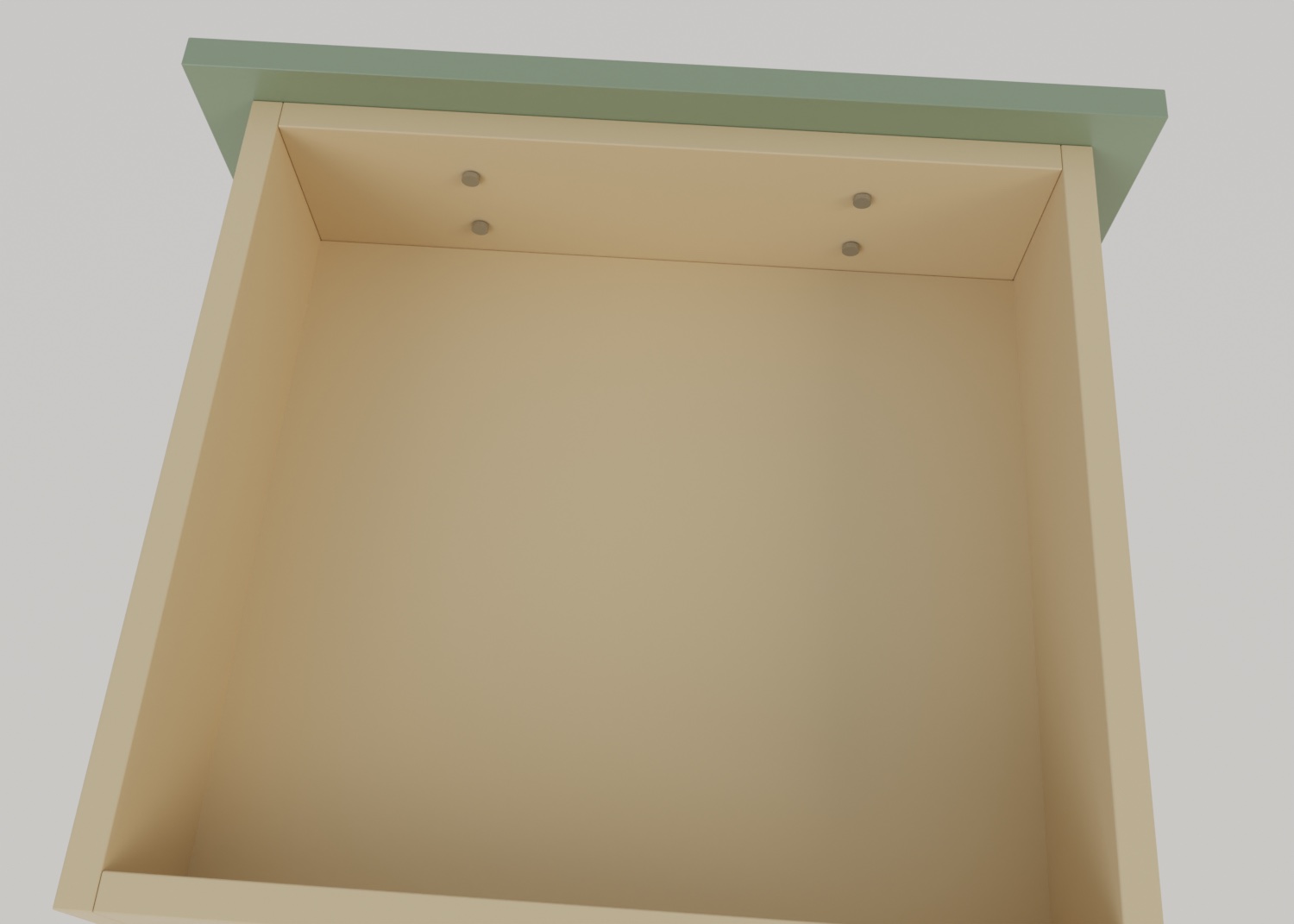
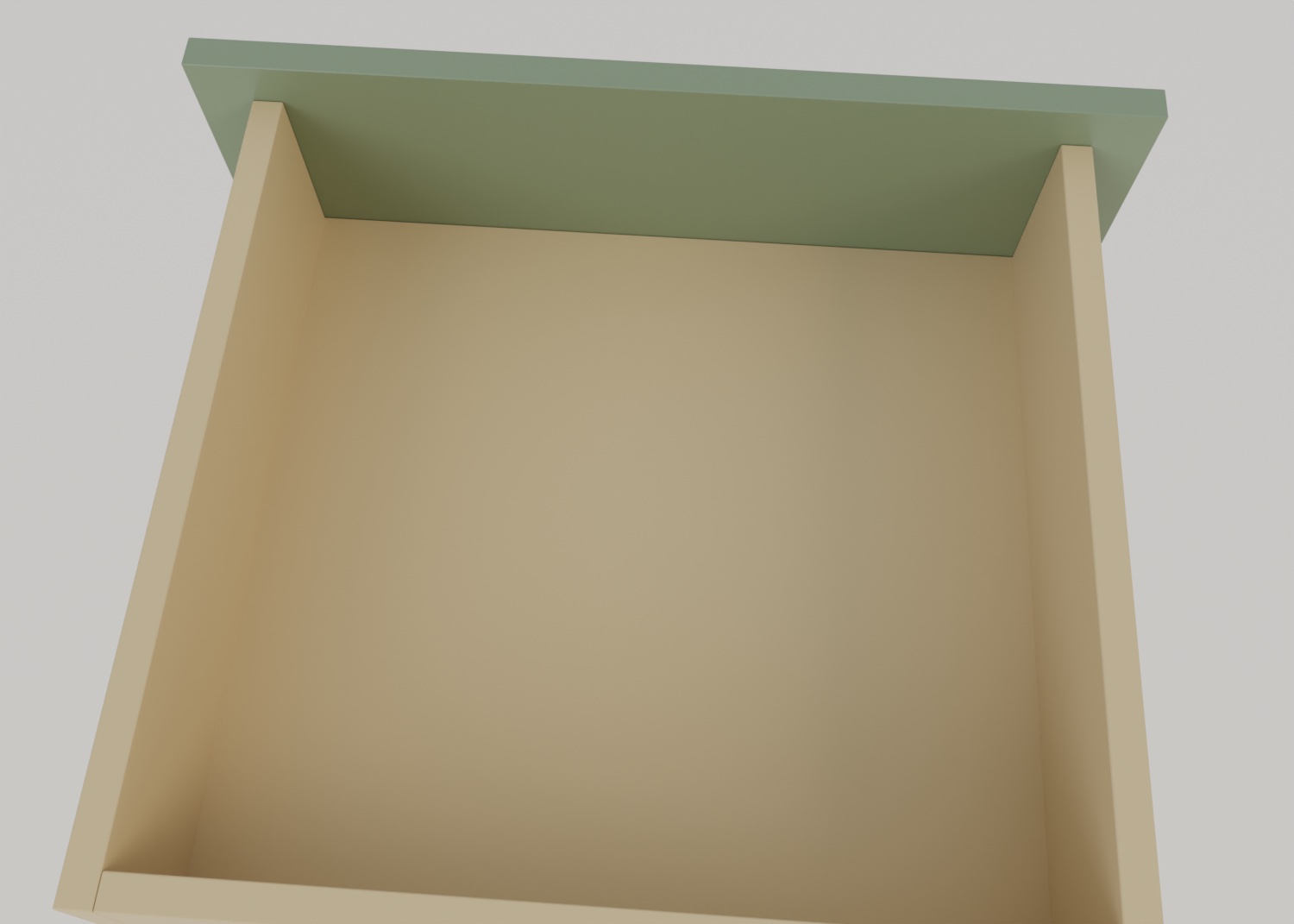
Before any question about joints, settle this one. The facade is the same panel either way. What changes is what it is fixed to. It is either screwed to a front wall the box already has, or the box has no front wall of its own and the sides are fixed straight to the back of the facade. Open the drawer and look down: the answer is written on the inside of the front.
A separate part, screwed onThe box is complete on its own, with its own front wall, and the facade is a SECOND panel screwed to that wall from inside. The screw heads are on the inner face of the box, where you can count them. The facade is the same panel either way; here there is a board wall between it and the drawer.Not separate: the sides land on itThe same facade, but nothing sits between it and the drawer: the sides are fixed straight to the BACK of it, so the facade is itself the front wall of the box. No sub-front, no screws, and nothing to adjust afterwards, because the joint put the front where it is.
Fitted kitchens use the separate front almost without exception, and the reason is adjustment: a panel that is screwed on can be shifted after the drawer is hung, so a run of fronts can be lined up flat. A front that is part of the box is fixed where the joint put it. How that panel then sits against the cabinet, flush in the opening or lying over it, is a different question, covered in inset vs overlay fronts.
Screwed butt joint: the cheapest box that is still a drawer
Four panels, screws through the side into the edge of the back, and a thin hardboard bottom stapled to the underside. Nothing is machined beyond cutting the panels to size, which is the whole appeal: it is the fastest drawer to make and it needs no fitting, no clamp and no CNC operation of any kind.
The weakness is structural and it is not subtle. A screw driven into the edge of particleboard is holding onto crumbs, since the board has no long grain to grip, and every time the drawer is yanked open the joint works a little looser. The applied bottom makes it worse rather than better: the drawer stands on its fixings, so a loaded box slowly pulls the staples through a 3 mm panel. Grooved bottoms brace a box against racking; a stapled one does not.
Where it is right: light storage, a desk pedestal, a bedroom chest, any drawer that holds socks rather than saucepans, and any job where the specification is a price. It works. Do not put the pan drawer of a kitchen on it.
Knock-down connectors: flat-pack that does not feel like it
A knock-down connector, and we fit Cabineo 8, is a fitting that sits in a pocket milled into the face of one panel and pulls a pin housed in the other. That detail is the point: everything is machined from one side, so the drawer panels go through the same flat CNC pass as the carcass, with no edge boring and no second setup. It is the reason this is our default rather than dowels, for one reason: it is the joint a machine can make in one pass and a person can assemble with an Allen key.
What you get:
It comes apart. Repeatedly, without damage. A glued box is a permanent object; a connector box ships flat, gets built in the room and can be taken down again when the kitchen moves.
Load in shear, not in threads. The connector clamps the two panels face to face rather than relying on screw threads biting into a board edge, the exact failure the butt joint has.
A grooved bottom. 4 mm HDF captured in a 6 mm groove in the sides and back, so the bottom cannot drop out and the box stays square under load.
One machining operation. No edge drilling means no second fixture, which is most of why a flat-pack drawer can be made accurately at a sensible price.
What it is not: invisible. A connector shows a cap on the inside face of the drawer back. On a kitchen drawer nobody will ever look at it; on a display piece with the drawer left open, they might.
Glued dowels: the cabinet shop's joint
Dowels and glue. A row of Ø8 dowels crosses the joint line, the box is clamped square, and when the glue cures the corner is stronger than the board around it. There is nothing to see from either side, nothing to come loose and no fitting to buy.
Two things follow from it being glued. First, it is permanent. The box will never come apart again without being destroyed, so it cannot be flat-packed and it cannot be sent as panels. Second, it needs a case clamp and cure time, which is a machine and a floor slot rather than a screwdriver. That is precisely why the flat-pack industry does not use dowels and why a fitted-furniture workshop does: the shop already owns the clamp, and its drawers are never coming apart anyway.
In birch plywood it is an excellent kitchen drawer, since the plywood does not swell like solid timber, it holds a screw, and the layered edge is honest enough that plenty of makers leave it exposed as a finish.
Dovetails: the joint that resists exactly the right force
A dovetail is not decoration that happens to be strong. Opening a loaded drawer pulls the front away from the sides, and the tails are cut so that this pull drives the joint together: it cannot come apart in the direction it is loaded, glue or no glue. That is why three-hundred-year-old drawers still have tight corners, and why the joint became the mark of a properly made one.
The practical consequences:
Thinner stock. Solid maple at 12.7 mm (½") is stronger in this joint than 16 mm board is in any of the others, so the box walls are thinner and the usable space inside is wider for the same opening.
It is bought, not milled flat. Dovetails want a dedicated machine, and most kitchen makers order boxes from a drawer-box shop by the millimetre rather than cut them. Budget for a lead time as well as a price.
It is solid timber. Which means it moves with the weather, wants a finish, and costs what hardwood costs. A dovetailed box in a damp utility room is money spent in the wrong place.
Where it belongs: a kitchen where the drawers get opened in front of people, and furniture where the joinery is part of what is being bought. It is the most beautiful option here and, in a room nobody visits, the most pointless.
Metal-sided system boxes: no corner to make at all
The premium kitchen answer is to stop building a wooden box. In a system box, Blum LEGRABOX, Hettich AvanTech and their class, the sides are the runner: a double-wall steel profile that carries the load, houses the slide mechanism and forms the wall of the drawer in one part. You buy the sides as a set and cut only a back and a bottom to fit between them.
What that changes:
Three panels instead of five. The sides leave the cut list entirely and become a hardware line. There is no corner joint to machine, glue or connect, because there is no wooden corner.
More room inside. A steel side is around 13 mm thick against 16 mm of board, and slim-line profiles go thinner still, and in a drawer that is space you can see.
The box comes in fixed heights. This is the real trade-off and it is easy to miss on a spec sheet. LEGRABOX exists in four side heights, 66.5, 90.5, 128.5 and 193 mm, so a system box does not fill its opening the way a box you cut yourself does. Our editor snaps the box down to the largest height that fits and shows you the result, rather than quietly drawing a box that cannot be bought.
The bottom drops in. The slot is part of the profile, so the 16 mm board bottom sits between the sides with no groove to cut.
It is the most expensive way to build a drawer and, in a kitchen, often the most defensible: the part that wears is engineered steel, the fit is the manufacturer's rather than the workshop's, and the whole assembly adjusts after it is hung.
Where the bottom sits, and why it matters
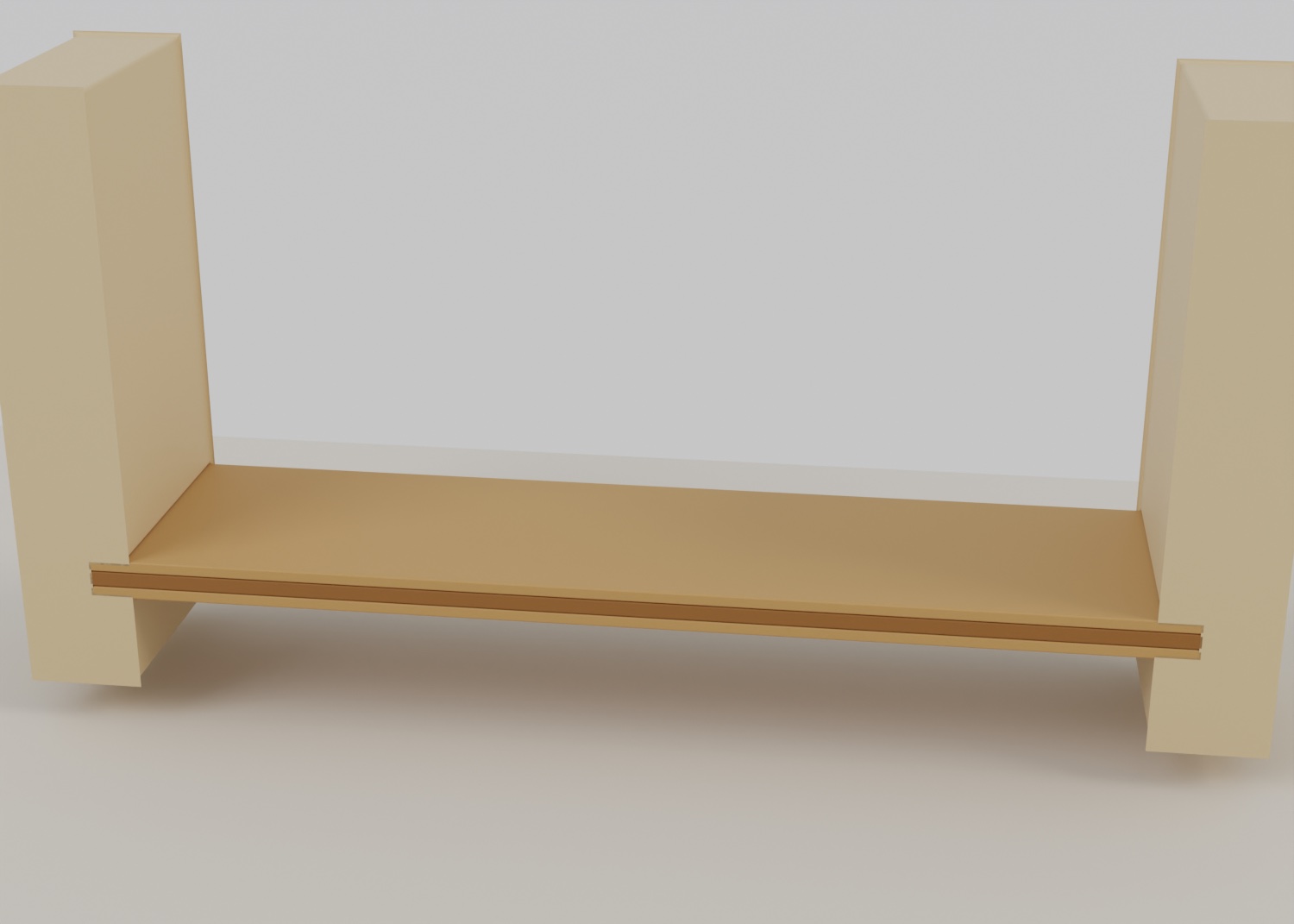
The bottom is the panel people think least about, and the one whose cut size changes most with how it is held. The two common ways sit at opposite ends of trouble: captured in a groove, or applied underneath. The box is cut through so you can see where the plywood bottom sits, and each way gives it a different size, which is why the bottom cannot be drawn until the construction is chosen.
In a grooveBottom = inside width + 6 mm each sideThe plywood bottom is captured in a dado in the sides and back, so it cannot fall out and it stiffens the whole box against racking. The panel is cut BIGGER than the inside of the box, and the extra is what lives in the groove.Applied underneathBottom = the full outer footprintThe plywood bottom is pinned under the assembled box, running the whole outer footprint. Nothing to machine, and the box stands on the fixings. Simple and quick, and how most budget drawers are closed.
Head to head
Construction
Screwed butt joint
Knock-down connector
Glued dowels
Cut dovetails, solid timber
Metal-sided system box
How the corner is held
Screws through the side into the edge of the back
Cabineo 8 at the two rear corners, fitted from one face
Ø8 dowels across the glue line
Interlocking tails and pins
None to make. The sides are the manufacturer's system
Box stock
16 mm melamine board
16 mm board
16 mm birch plywood
12.7 mm (½") solid maple
Steel double-wall sides (bought), 16 mm board back and bottom
Bottom
3 mm hardboard, applied underneath
4 mm HDF in a 6 mm groove
6 mm plywood in a 6 mm groove
6.4 mm (¼") plywood in a 6 mm groove
16 mm board, captured by the side profile
Panels cut per drawer
5: 2 sides, back, bottom, front
5: 2 sides, back, bottom, front
5: 2 sides, back, bottom, front
5: 2 sides, back, bottom, front
3: back, bottom, front (the sides are hardware)
Can it be taken apart
Yes, but the screw holes do not survive many rounds
Yes, repeatedly. That is what the connector is for
No. The glue line is the joint
No
Yes. It is designed to be assembled on site
Strength
Lowest. The load hangs on screws driven into a board edge
Good. The joint carries the load in shear rather than in threads
High. Glued plywood, nothing to work loose
Highest. The joint resists the pull that opens the drawer
Highest in service. The side, the runner and the load path are one part
Where it belongs
Light storage, budget furniture, anything where price is the spec
Our standard: flat-pack shipping, one CNC pass, no edge boring
Cabinet shops with a case clamp; fitted furniture built to stay put
Premium kitchens and furniture; usually bought from a drawer-box shop
Kitchens where the drawer is the feature; slim sides, most space inside
Typical cost per drawer box
$8–18
$14–28
$20–40
$45–90
$45–95
Costs are retail bands for one drawer box as of July 2026. Materials and making, without the runners, which are priced separately on the drawer slides page. Treat them as orientation, not a quote.
What the choice does to the cut list
This is not a finish option. Changing the construction changes which panels exist and how big they are, which is why it is a decision made while the cabinet is a drawing. Take one real drawer: a 564 × 200 mm opening in a 560 mm deep cabinet, on side-mount runners that ask for 12.5 mm of clearance each side. The box comes out 539 mm wide and 190 mm tall in every construction, and then they part company:
Connector box (our default): five panels. The 4 mm bottom is cut 519 mm wide, 6 mm wider than the inside of the box on each side, because that is what sits in the groove, and 540 mm deep.
Screwed butt box: five panels, but the 3 mm bottom is cut to the outer footprint, 539 × 550 mm. It is not a small panel that got bigger; it is a different panel doing a different job.
Dovetailed box: thinner sides mean a wider inside: the back grows from 507 mm to 513.6 mm in the same opening. Every millimetre of side you do not use is a millimetre of drawer you get.
Metal-sided box: three panels, since the sides are gone from the cut list altogether. And the box is 128.5 mm tall, not 190: it snapped down to the nearest height the system is made in.
The connector rows follow the same rule. Cabineo appears in the drilling only for the connector construction. A dowelled, dovetailed or screwed box has no connector to buy, and a system box has no wooden corner to connect. Pick the construction and the cut list, the drilling and the hardware tally all rebuild around it.
Box and runner are two decisions, not one
These get conflated constantly, usually by a showroom saying “dovetail drawers with soft-close” as if it were a single product. It is two: dovetail describes the box, soft-close describes the runner. You can have either without the other, and the pairings that go wrong are the ones where the money landed on the wrong half.
Cheap box, expensive runner. A stapled hardboard bottom gliding out on concealed undermounts. The drawer feels wonderful and sags under a load of pans. Money in the wrong half.
Expensive box, cheap runner. A dovetailed maple box on partial-extension rollers. Beautiful joinery you cannot reach the back of, banging shut. Also money in the wrong half.
Matched. The box is built for the load it will carry, the runner chosen for the room it lives in. See drawer slides for that half of the decision.
One genuine dependency runs between them: a system box is not a box choice and a runner choice, it is one purchase that settles both. Everywhere else the two are free.
So which one
Kitchen drawers that carry weight: connector, dowel or metal. Pan drawers, cutlery, everything opened daily. Any of the three is honest; pick by how the cabinet reaches you. Flat-packed and built on site: connector. Made in a shop and delivered whole: dowel. Built to look and feel like the showroom: metal-sided.
A kitchen where the drawers are the feature: dovetail or metal. These are the two that read as quality when the drawer is open, and they get there opposite ways: one by showing craft, the other by showing engineering. Choose which language the room speaks.
Wardrobe and bedroom: connector. Light loads, lots of drawers, and the cost of the box multiplies fast. The default is the default for a reason.
Garage, utility, anything holding tools: dowel or connector. Strength matters, appearance does not, and solid timber in a damp room is money spent where it will not be seen.
Screwed butt joints, only where price is the specification. They work in light service and they are the cheapest drawer that can be made. Know what you have bought: a joint that loosens and a bottom the load hangs from.
Pick the construction, see the panels change
Drawer box construction is a choice on your design, not a detail settled in the workshop. Switch a cabinet between a screwed box, a connector box, dowels, dovetails and a metal-sided system box, and the cut list, the drilling and the price all rebuild around it, including the two side panels that disappear when the sides are bought instead of cut.
For a kitchen drawer that carries weight, the best value is a knock-down connector box or a glued dowel box: both hold the corner far better than screws driven into a board edge, and both keep the bottom in a groove so the box stays square under load. The strongest wooden corner is a cut dovetail in solid timber, because the tails resist exactly the pull that opening a loaded drawer applies. It is also the most expensive to make and usually bought in rather than cut. A metal-sided system box sidesteps the question by making the side and the runner one bought part. The genuinely weak option is a screwed butt joint with the bottom stapled on underneath: fine for socks, wrong for saucepans.
Dovetail or dowel drawer boxes: which is better?
Dovetails are stronger and dowels are more practical. A dovetail is cut so that pulling the drawer open drives the joint together, so it cannot fail in the direction it is loaded; it also uses thinner stock, typically half-inch solid timber, which leaves more usable width inside the same opening. A glued dowel joint in birch plywood is invisible, easily strong enough for any household drawer, does not move with humidity the way solid timber does, and costs roughly half as much. Both are permanent: neither can be flat-packed. Choose dovetails when the joinery is part of what is being bought, dowels when the drawer just has to be excellent.
Should a drawer bottom sit in a groove or be nailed on?
In a groove, wherever the drawer will carry anything. A grooved bottom is captured in a dado in the sides and back, so it cannot drop out and it braces the whole box against racking. The panel is deliberately cut wider than the inside of the box, and the extra is what lives in the groove. An applied bottom, stapled or screwed to the underside, needs no machining and is what budget furniture uses, but the drawer then stands on its fixings and a loaded box will eventually pull them through a thin panel. A third case is neither: in a metal-sided system box the slot is part of the side profile, so the bottom simply drops between the sides.
What is a metal-sided drawer box?
A drawer system where the sides of the box are the runner. Blum LEGRABOX, Hettich AvanTech and their class supply a double-wall steel profile that carries the load, houses the slide mechanism and forms the drawer wall in one part; you cut only a back and a bottom to fit between them. It gives more space inside, around 13 mm of steel against 16 mm of board, no corner joint to make, and a fit set by the manufacturer rather than the workshop. The trade-off is that the box only exists in the system's fixed side heights, LEGRABOX being 66.5, 90.5, 128.5 and 193 mm, so it does not fill its opening the way a box cut to size does.
Are plywood drawer boxes better than particleboard?
Yes, in the ways that matter to a drawer. Plywood holds a screw and a dowel far better than particleboard because it has continuous long grain in alternating layers, it is stiffer for the same thickness so the sides flex less under load, and it does not crumble at the edge, which is where a butt-jointed board box fails. It also survives damp far better, which matters under a sink. Particleboard with a melamine face is cheaper, perfectly stable, and entirely adequate for light drawers, especially when the corners are held by a connector rather than by screws in the board edge.
Can a flat-pack drawer box be strong?
Yes, if the corner is a connector rather than a screw. The weakness people associate with flat-pack is the fixing rather than the demounting: a screw driven into the edge of a board, which has almost nothing to grip and works loose every time the drawer is pulled. A knock-down connector such as Cabineo clamps the two panels face to face and carries the load in shear instead, and it is machined from one face so the panels need no edge drilling. That box ships flat, assembles with an Allen key, comes apart again without damage, and holds a load properly. What flat-pack cannot do is dowels or dovetails, because both are glued and permanent.
Does drawer box construction change the cut list?
Substantially, which is why it belongs in the design and not in the workshop. It changes the thickness of the sides and back, and thinner sides mean a wider inside for the same opening, so a dovetailed box gains several millimetres of usable width over a board box. It changes the size of the bottom panel outright: grooved bottoms are cut bigger than the inside of the box, applied bottoms are cut to the whole outer footprint, and a captured bottom is the inside width exactly. It changes what hardware appears, since only the connector construction puts connectors in the drilling. And a metal-sided box removes the two side panels from the cut list altogether, leaving three panels instead of five.
Is drawer box construction the same thing as the drawer slides?
No, and conflating them is the most common way to spend money in the wrong place. The construction is how the box is made: the joint at the corners, the stock, how the bottom is held. The slides are what the box rides on, and they decide extension, soft-close and whether you see hardware down the side of the drawer. They are chosen independently: the same concealed undermount runner will carry a stapled hardboard box and a hand-cut maple one. The one exception is a metal-sided system box, where the side and the runner are a single purchase that settles both questions at once.
How much does a drawer box cost?
As of July 2026, roughly $8–18 for a screwed butt-jointed board box, $14–28 for a connector box, $20–40 for a glued dowel box in birch plywood, and $45–90 for a dovetailed solid-timber box bought from a drawer-box shop. A metal-sided system box lands around $45–95 for the sides and fixings, with the board back and bottom on top. Those are per drawer box and exclude the runners, which are bought separately per pair. The multiplier is what catches people out: a kitchen with fifteen drawers turns a $30 difference per box into $450.