
Kitchen · Cost

How much do custom kitchen cabinets cost?

Cabinets are priced per linear foot, and “custom” covers a huge range depending on how they're made. Here's what drives the number, what actually makes up the price of a single cabinet — and why designing your own online lands near the bottom of that range.

How cabinet pricing works

Kitchen cabinets are quoted per linear foot — you measure the length of wall the cabinets run along and multiply. A typical kitchen has 20–30 linear feet of cabinetry counting both base and wall runs. Countertops, appliances, and installation are quoted separately.

The per-foot number swings widely depending on how the cabinets are made — stock boxes off the shelf sit at one end, a local shop's full-custom work at the other, with plenty in between. Rather than throw ranges at you, it's more useful to see what actually moves the number.

What actually drives the price

Two cabinets the same size can price very differently. In order of how much they move the number:
  • Size and quantity — more linear feet, taller runs, and deeper cabinets use more of every material and more labour.
  • Drawers vs doors — a drawer bank costs more than a door-and-shelf cabinet: each drawer is its own box on its own pair of slides, so the hardware and machining stack up.
  • Front style — the fronts are the single biggest lever you control. A flat slab is the floor; a shaker or a milled front adds shaping and material and moves that line well up.
  • Hardware — soft-close hinges and slides, pull-outs, and organisers each add a real per-piece cost across every door and drawer.
  • Carcass material and edge — the box board, the back panel, and how much edge gets banded. Honest surprise: the raw board is a smaller slice than most people expect (see the make-up below).
  • The markup you don't see — showrooms, designers, and dealer margins are baked into a traditional custom quote, before a single panel is cut.
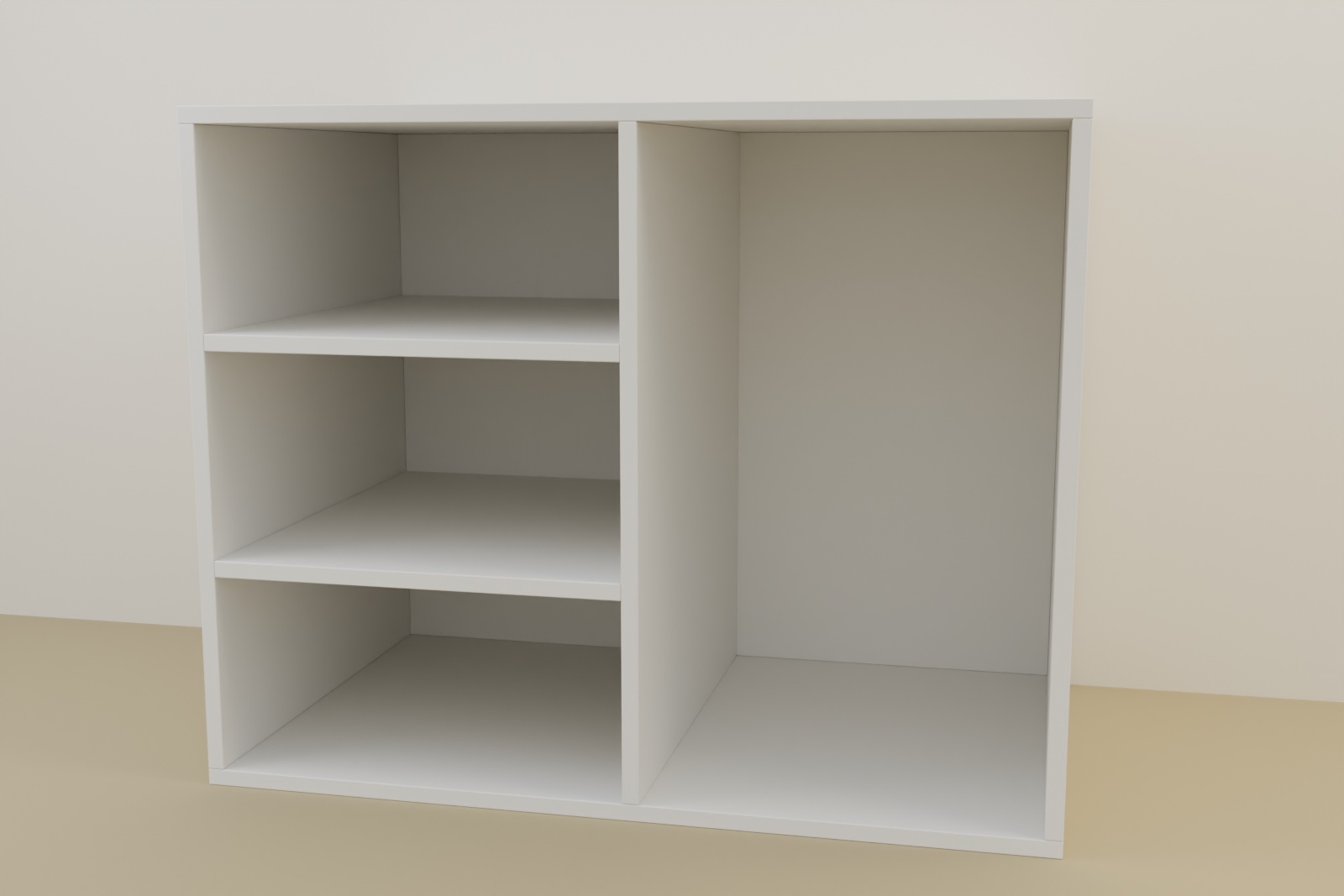
An open white cabinet carcass with no fronts — five 18 mm melamine panels and a thin back, the bare box you pay board and cutting for.
The box — board, back and cutting. A smaller slice of the price than most people expect.
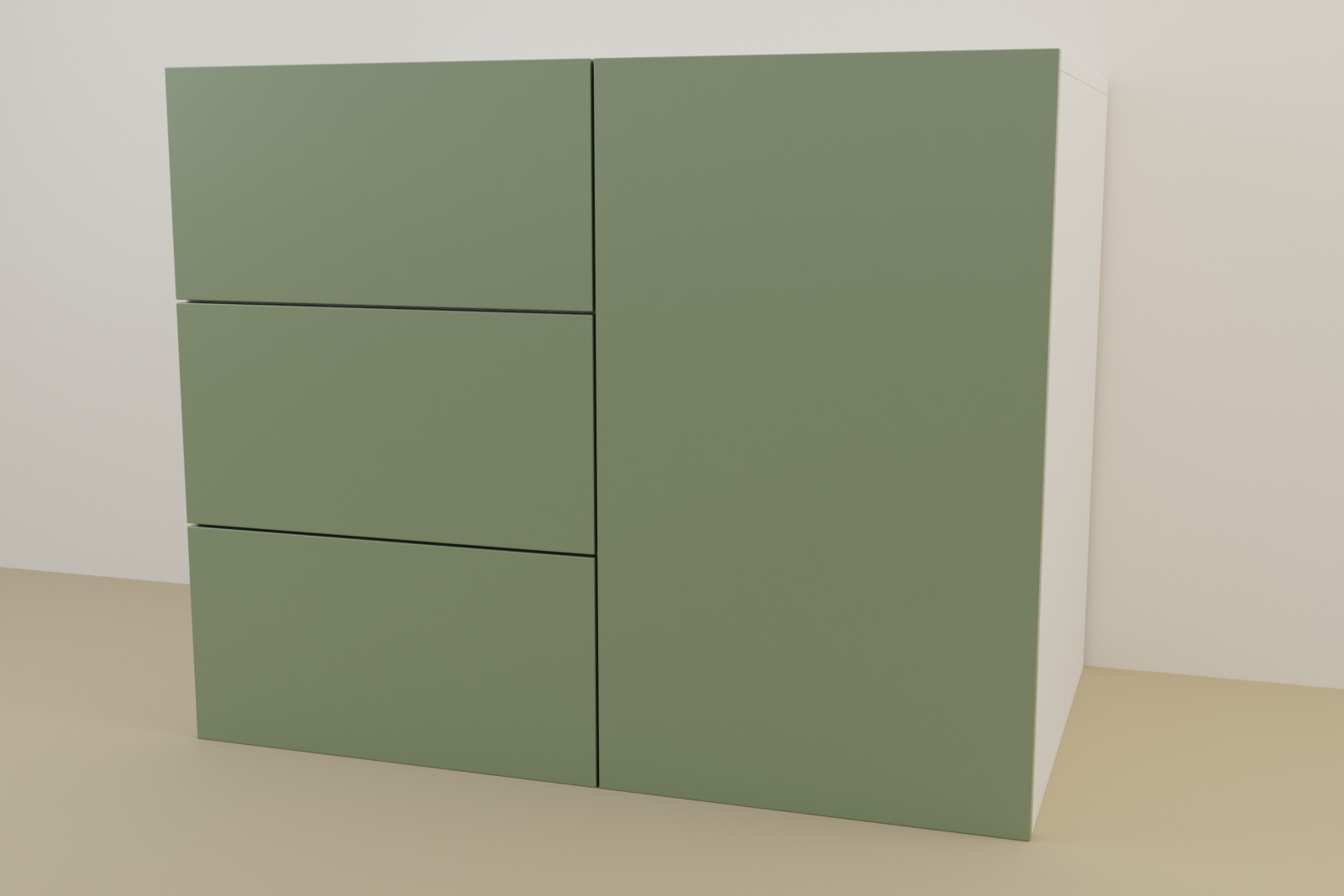
The same cabinet finished — a three-drawer bank beside a full-height door, sage-green overlay fronts on a white carcass.
Finished — fronts, hinges, slides, connectors and assembly do the rest.

The sample cabinet: one 900×720×560 mm (≈35×28×22 in) base unit — three drawers and a door.

What you're actually paying for

We won't put a number on a cabinet here — your real figure depends on your design and shows live in the editor. What's worth seeing is the make-up, and how it shifts as cabinets go from mass-produced to built-to-order. The proportions below are drawn from cabinetmakers' own cost breakdowns, not a price list.

Where the money goes, by segment

Share of the cabinet price. Moving up-market, labor grows and materials shrink — the board costs about the same, but more of the price becomes the work of building to your sizes.

  • Materials
  • Hardware
  • Labor
  • Finishing
  • Overhead + profit
Flat-pack / RTAIKEA-style, mass-produced
Stockoff-the-shelf sizes
Semi-customstock boxes, more options
Full custombuilt to your sizes

Illustrative shares synthesised from cabinetmaker cost breakdowns (WOODWEB shop data) and industry cost guides — proportions, not a quote. Each bar totals 100%; delivery and installation are separate.

Two things stand out. First, labor is the biggest lever in custom work — in a full-custom cabinet it runs roughly two to three times the material cost, because every box is cut, drilled, and assembled to your sizes. Second, within the materials themselves the fronts cost more than the box — which is why the door style you pick is the material choice you feel most:

Inside the materials
50%
35%
15%
  • Doors & drawer fronts the style you pick lives here
  • Carcass board sides, top, bottom, shelves
  • Edge banding + back tape and the thin back panel

Within the materials bucket. Swings with door style — plain slab fronts sit lower, solid-wood or painted shaker higher.

The takeaway is the shape, not a total. The raw carcass board is a smaller slice than most people expect — the fronts, the hardware, and above all the laborof building to your sizes are the bigger part. That's why upgrading the box material moves the number less than you'd think, and why the front style, the number of drawers, and how much soft-close hardware you spec are the levers you actually feel.

Why designing your own costs less

Most of a traditional custom quote isn't the cabinet — it's the showroom, the sales commission, and the dealer margin between the factory and you. When you design the layout yourself and we ship direct from our workshop, that middle layer disappears. You get true made-to- measure cabinetry at a price that sits near the bottom of the custom range — often close to semi-custom stock.

Read how made-to-order works, or measure your kitchen before you price it out.

Delivery, assembly and installation

The number in the editor is for the cabinets. Getting them to you and onto the wall is separate, and you have options: we deliver to your door, or you collect from one of our locations by arrangement with a manager. Units ship flat-packed, so you can assemble them yourself, bring in a local fitter, or have us send an installer where we cover your area. Countertops and appliances are their own line entirely.

See your real number, not a range

Lay out your kitchen in the editor and the price for the cabinets updates as you add cabinets, drawers, and hardware — delivery and install are quoted separately. The number is there as you build, no quote to wait for.

Frequently asked questions

How much do custom kitchen cabinets cost per linear foot?
Traditional full-custom cabinets run well above stock and semi-custom per linear foot, mostly because of showroom, design, and dealer margins. Because you design cabi.now cabinets yourself and we ship direct without that markup, our price sits near the bottom of the custom range — you see the exact figure in the editor as you build.
What's the average cost of cabinets for a whole kitchen?
A typical kitchen has 20–30 linear feet of cabinetry, so the total is the per-foot price times that length. Countertops, appliances, and installation are priced on top and vary by kitchen.
What actually makes one cabinet cost more than another?
Size, the number of drawers, the front style, and how much soft-close hardware you spec move the number most. The raw box board is a smaller slice than people expect — hardware, plus the machining and assembly around it, adds up to more. You see the exact figure for your own design in the editor.
Are custom cabinets worth it over stock?
If your kitchen has odd wall lengths, a high ceiling, or awkward corners, custom pays off by using every inch instead of filling gaps with strips. When custom is priced like ours — without the showroom markup — the gap over stock is small enough that the better fit is usually worth it.
Is installation included in the price?
No — the price is for the cabinets themselves; delivery and installation are separate. We deliver to your door, or you can collect from one of our locations by arrangement with a manager. You can assemble the flat-packed units yourself, bring in a local fitter, or have us send an installer where we cover your area.