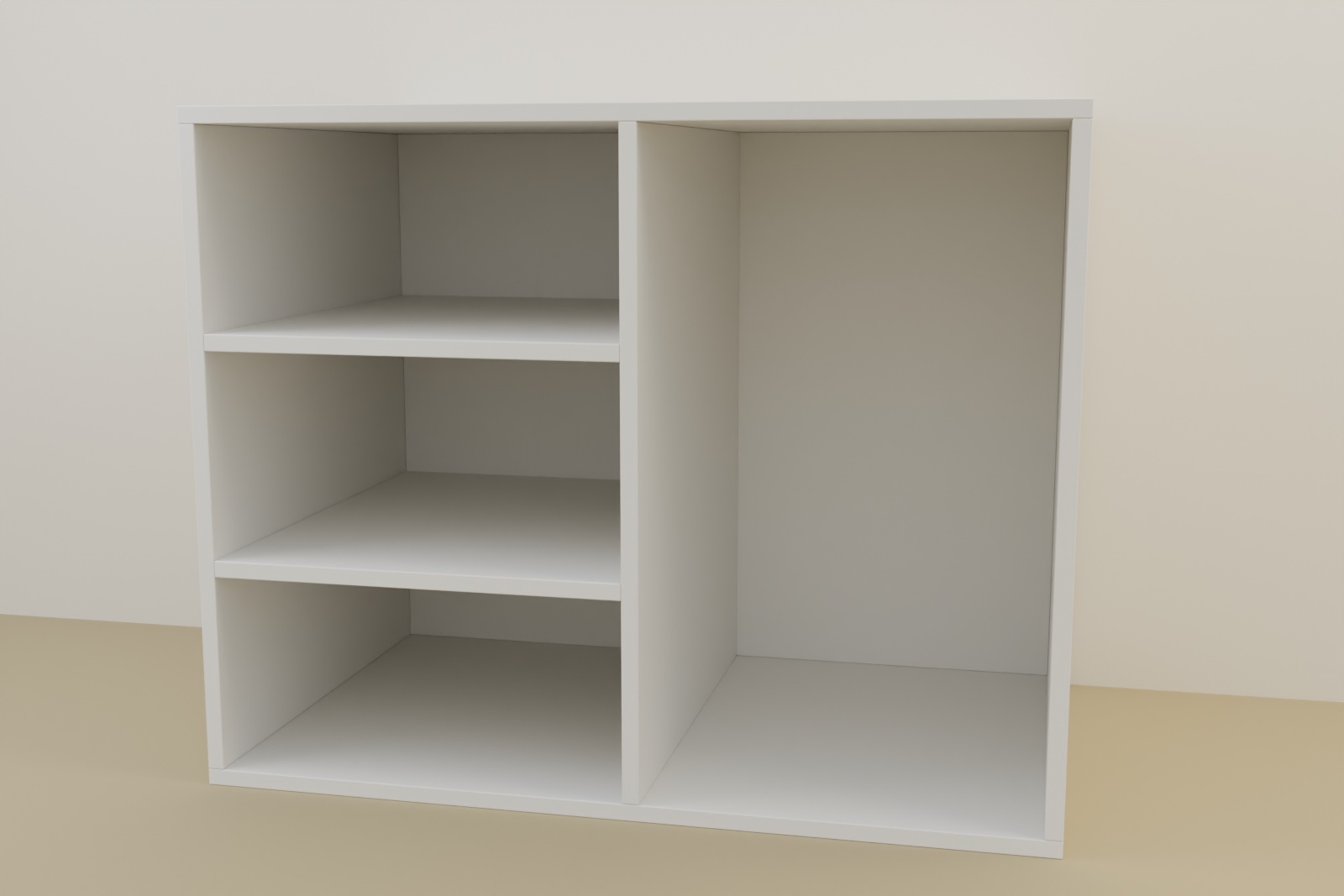
Real made-to-order cabinetry: the carcass is cut to your kitchen, not picked from a list of sizes. Design it here, watch the cost move as you go, and we build it to spec. Below: what custom means, how ours is built, and where it loses to a stock box.
The word does a lot of work it hasn't earned. At most big-box counters, “custom” means choosing a door style and a finish for boxes that still arrive in fixed 3-inch (76 mm) increments. The doors are yours. The sizes are not.
Custom means the carcass itself is cut to your numbers. A 29¾-inch (756 mm) gap between a wall and a window gets a 29¾-inch cabinet, rather than a 27-inch (686 mm) box and a strip of painted filler pretending to be joinery. That distinction is the whole thing. Everything else, colour, hardware, door style, is available somewhere at every price point.
A useful test when you're reading a quote: ask what happens to the leftover inches. If the answer involves a filler, a scribe or a panel, the cabinets are stock and the word is decoration.
What you can change
Every dimension: width, height and depth, per cabinet, anywhere from a few inches up to 16 ft wide and 8 ft tall. Set the number the wall gives you.
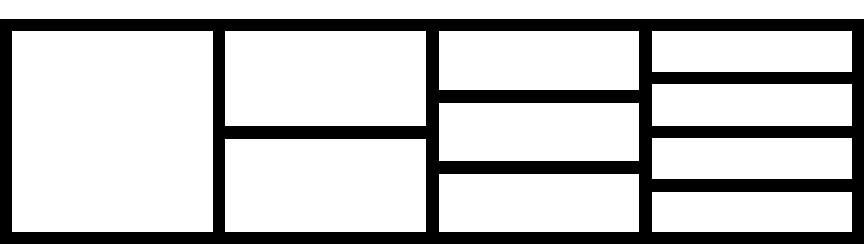
The internal layout. Split any cabinet into drawers, doors, shelves and open compartments, then split those again. The grid is yours, not a list of configurations.
Fronts: inset or overlay, doors or drawers, single or double, hinged from whichever side the room wants.
Colour. Carcass and fronts are chosen separately, so a two-tone kitchen costs nothing extra.
Hardware: hinges, runners, handles and legs picked from the catalogue below rather than assigned to you.
The parts nobody shows you: back panel type, toe-kick height and recess, edge banding coverage, and whether the top is a panel, a rail, or open stretchers under a worktop.
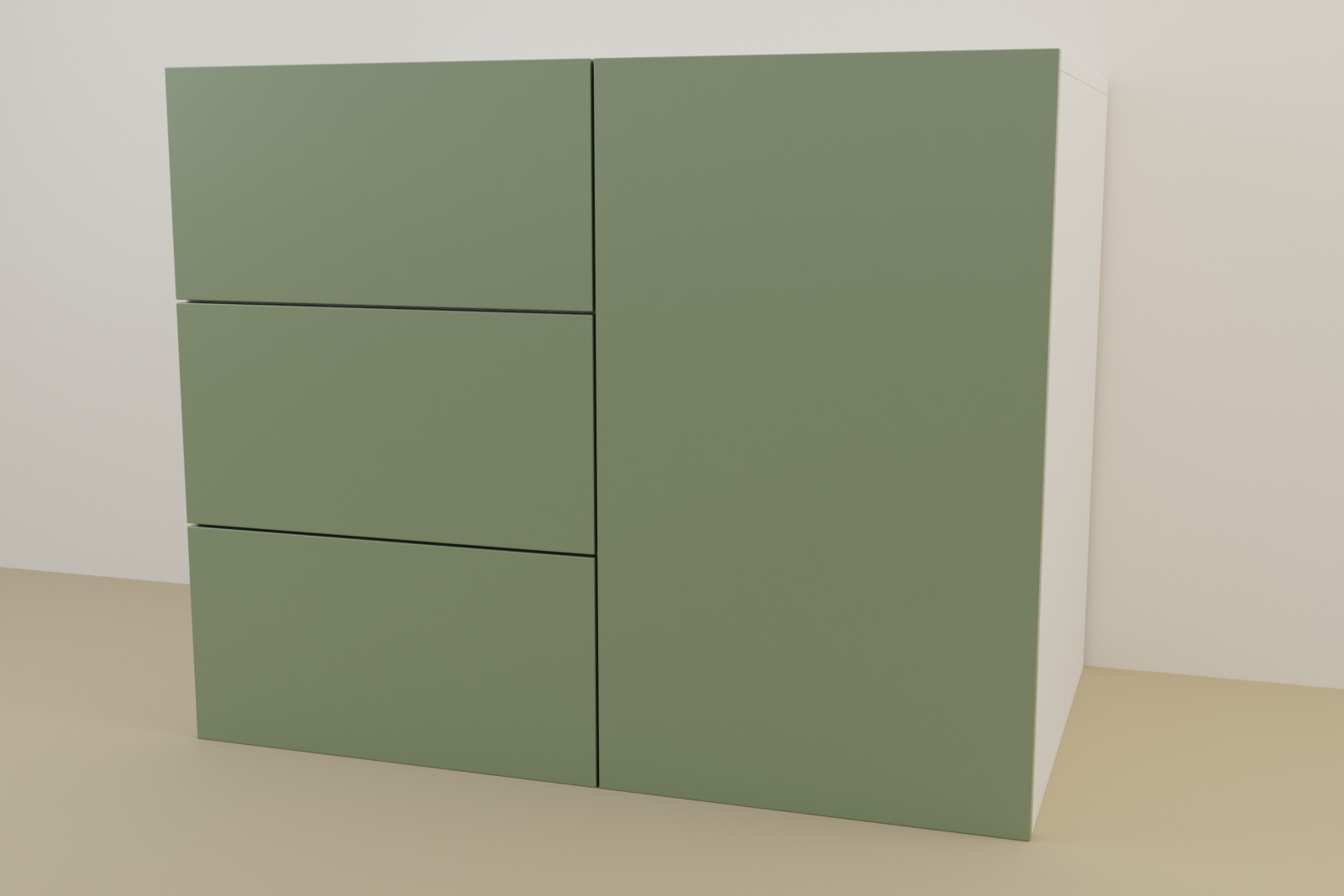
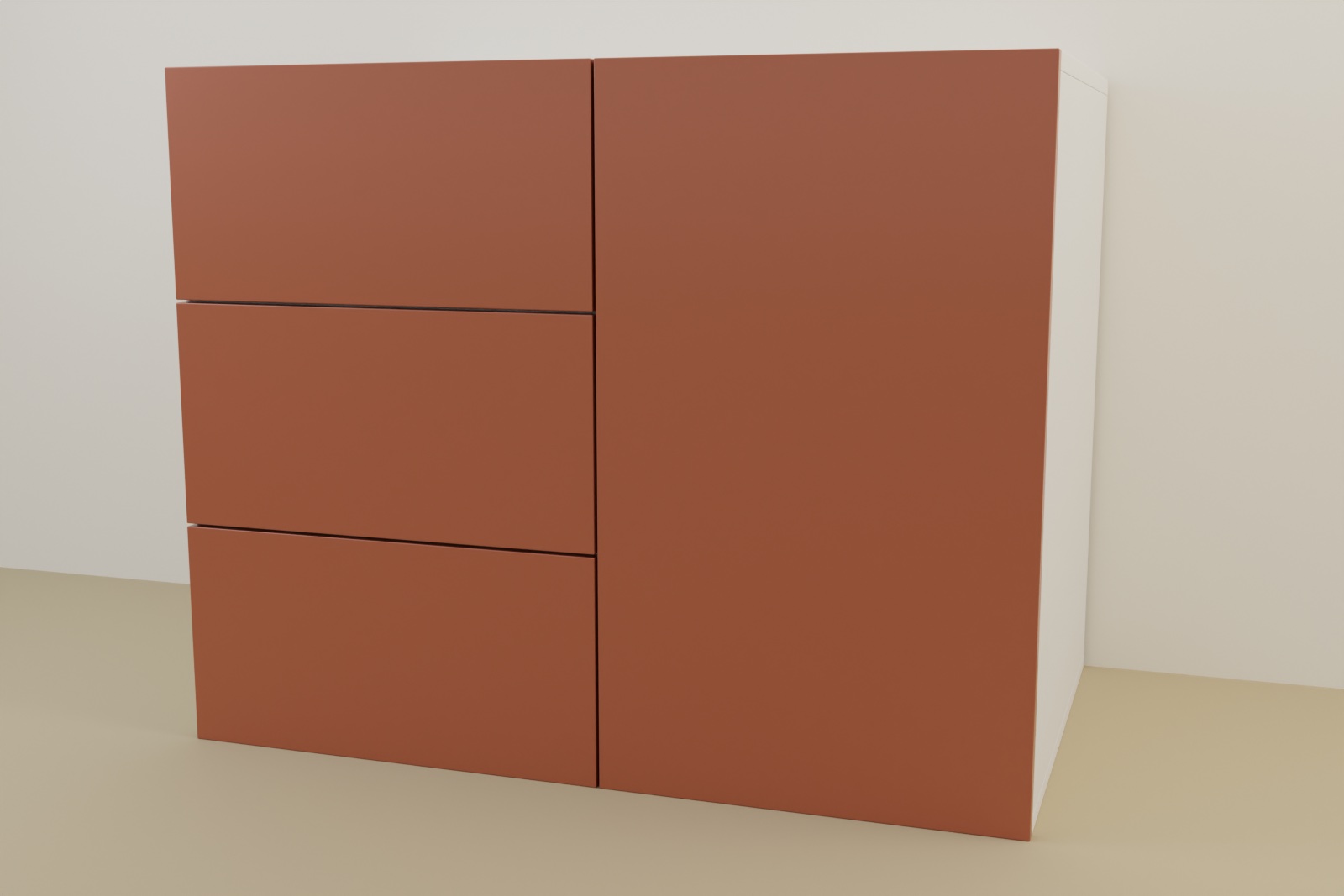
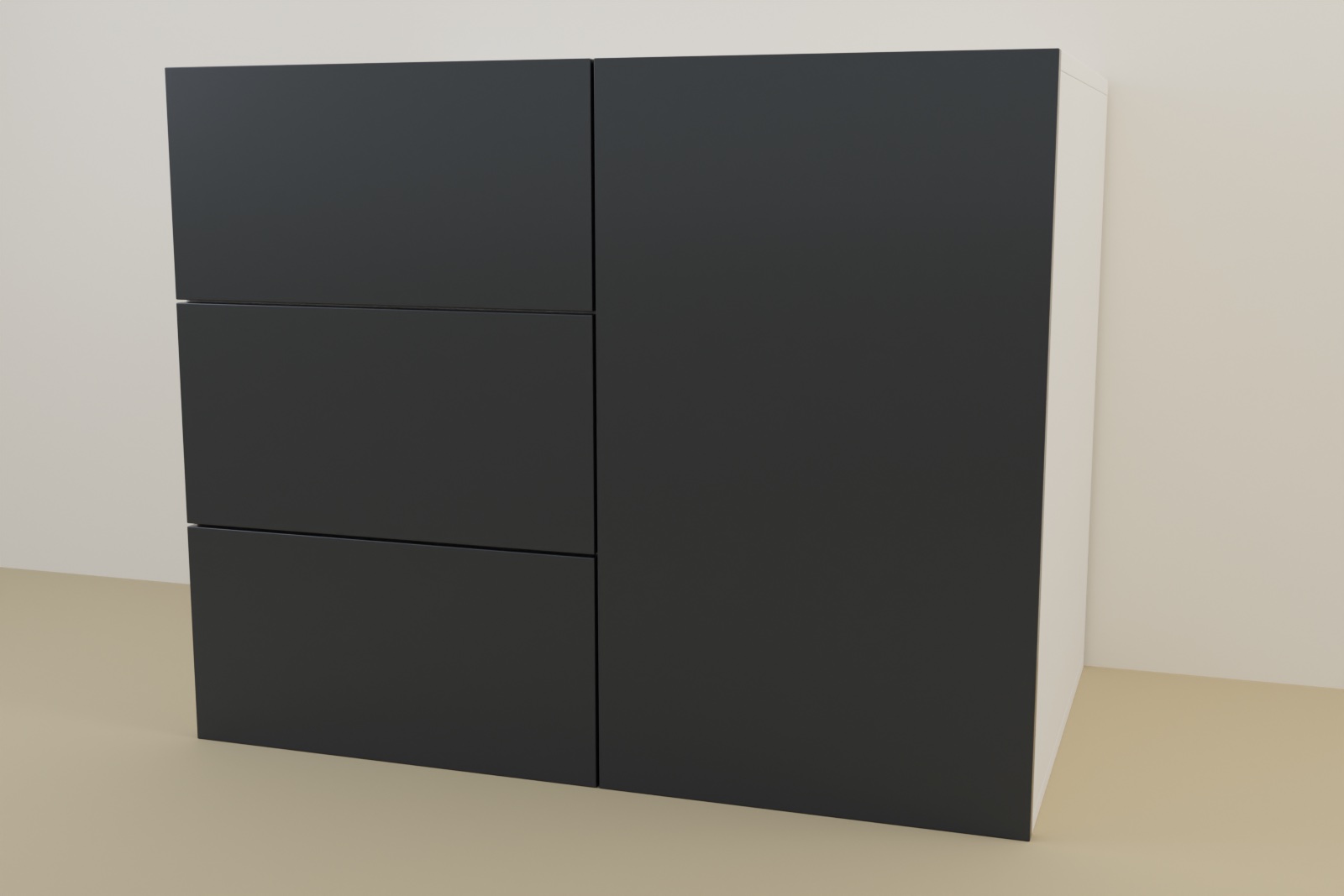
Colour is the easiest one to picture, since the very same cabinet reads completely differently depending on the front:
Sage greenClayGraphite
How ours are built
The spec below is the whole of it. It's worth reading line by line against any quote you're holding. Most of these are questions a showroom answers only if you ask.
Part
What it is
Detail
Construction
Frameless
European full-access. No face frame across the opening, so the drawer is as wide as the cabinet allows.
Carcass
18 mm melamine board
The board class most European kitchens are built from. Edges you can see are banded in 2 mm ABS.
Fronts
18 mm MDF
Doors and drawer fronts, inset or overlay, in the colour you pick.
Back
4 mm HDF or 18 mm structural
Thin panel in a groove or surface-mounted, or a full-thickness back that squares the cabinet.
Assembly
Face-fixed connectors
Cabinets go together with a hex key, with no edge boring and no bolt heads showing through the side panel.
Hardware
Premium soft-close
Soft-close hinges and full-extension runners from the top of the market. They cost a little more than budget fittings and outlast them by years, so the drawer still closes softly after a decade of daily use.
Handles & legs
Adjustable feet, knobs, pulls, gola
Adjustable feet from 100–200 mm, or none. Knob, 96/128 mm pull, milled gola finger-pull, or handleless.
The frameless carcass with its fronts removed. 18 mm panels, cut and split into exactly the compartments your layout calls for.
One thing worth being plain about: the carcass is melamine-faced board, not plywood. That's the standard nearly every European frameless kitchen is built from, it stays flatter than plywood across a wide panel, and it takes the face-fixed connector properly. If you specifically want a plywood box, we're not the right answer and a local shop is.
Fronts come two ways. Inset sits flush inside the carcass, or overlay, sitting proud and near-seamless. It changes both the look and the price. See inset vs overlay fronts for the two side by side.
Ours are frameless, with no face frame across the front, so the drawer is as wide as the box and nothing blocks the reach inside. Most U.S. stock is face-frame, and that frame costs you the opening. See frameless vs face-frame for the two side by side, and what a face frame is made of.
Underneath, the box sits on adjustable legs behind a clip-on toe kick, so it levels on an uneven floor and stays up off the wet. See how the base works , legs, plinth and toe kick, for the four ways a cabinet meets the floor.
Custom vs stock, IKEA, semi-custom and a local shop
Five ways to buy a kitchen, and custom is the right answer for maybe two of them. The honest version follows: the case for each, and what it costs you.
Option
Per linear ft
Sizes
Carcass
Stock / RTA
$100–300
Fixed, 3" (76 mm) steps
Particleboard, usually face-frame
IKEA (SEKTION)
Stock band
Fixed module sizes
Melamine board, frameless
Semi-custom
$150–650
Stock boxes, limited mods
Plywood or particleboard
Local custom shop
$500–1,200+
Anything
Your choice
cabi.now
Live in the editor
Anything
18 mm melamine, frameless
Dollar figures are typical U.S. market ranges for cabinetry only, counters and install excluded. See the cost breakdown for what moves them.
Stock / RTA
For
Cheapest per foot, by a wide margin.
On the shelf now: carry it home this weekend, or a couple of weeks for a special order.
You can open a drawer before you buy it.
Unopened boxes go back. Nothing about the order is bespoke, so nothing is stranded if you change your mind.
Outlet and clearance stock goes cheaper still, if you can build the kitchen around what's in the bin.
Against
Widths jump in 3" (76 mm) increments, so the leftover gap gets a filler strip, which is dead space you paid to hide.
Heights and depths are fixed. A low window or a 9-ft ceiling means a compromise, or a soffit full of nothing.
Corners tend to end up blind, and the back half of one is space you own but can't reach.
The face frame eats into the opening, so the drawer inside a 24" (610 mm) cabinet is a good deal narrower than 24".
Finish range is whatever the line offers this year, and matching it in five years is luck.
IKEA (SEKTION)
For
Frameless, so openings are full width: the same construction idea as custom.
The hardware is good, and the warranty is long.
Cheap for what it is, and thoroughly documented: every part is replaceable and the instructions are honest.
You can go and stand in front of it before deciding.
Against
Still fixed sizes. Fewer gaps than 3" (76 mm) stock, but you're still filling them.
Depth and height options are a short list, and the list is theirs, not yours.
The look is recognisable. Fronts from other suppliers fix that, at extra cost and effort.
Assembly is all yours, and a full kitchen is a lot of boxes.
Ranges get discontinued. Adding a matching cabinet in a few years may not be possible.
Semi-custom
For
Wide finish and door range. This is what you're paying for over stock.
Width reductions and some modifications are available, so the worst gaps close.
A dealer measures, orders and usually installs. If it's wrong, it's their problem.
Better built than base stock, and it arrives assembled.
Against
It's still a stock box underneath. The flexibility has walls, and you find them exactly where your kitchen is unusual.
Showroom, designer and dealer margin are all inside the number.
Weeks of lead time, and the clock starts after the design is signed off.
Quotes are hard to compare, since every dealer bundles differently, on purpose.
Local custom shop
For
Any size, any material, any style. Curved, angled, matched to existing millwork: all on the table.
Someone local is accountable, measures the room themselves, and installs it.
They can solve the thing no catalogue solves.
Against
The most expensive option, and the range is wide enough that the same kitchen can differ twofold between shops.
Long lead times, months rather than weeks.
Quality swings hard from shop to shop, and you're judging it from a portfolio.
You usually don't see it until it's built.
cabi.now
For
Any size. The carcass is cut to your number rather than chosen from a list.
You see it in 3D as you build, and a cost estimate updates as you add cabinets, drawers and hardware. No waiting on a quote.
Frameless, so the opening is the full width of the box.
You pick the hardware yourself, the best soft-close fittings on the market, instead of taking what the line ships with.
No showroom and no dealer sit between the design and the price.
Against
You measure, and the measurement is your responsibility. A cabinet cut to a wrong number can't be restocked, since it fits your kitchen and nobody else's.
There's no showroom. You can't run a hand over the board before you decide.
It arrives flat-packed. You assemble it, bring in a local fitter, or have us send an installer where we cover your area.
It's made after you order, so it's never the same-day answer a stock box off the shelf is.
The carcass is melamine board, the European standard and a good one. If you specifically want plywood, a local shop is your answer rather than us.
When custom isn't worth it
We'd rather you didn't order a kitchen you regret. Buy stock if:
Budget is the binding constraint. Custom is more per foot than RTA and always will be. A well-fitted stock kitchen beats a custom one you had to cut in half.
You're renting, or leaving inside a few years. Cabinets cut to this room are worth nothing in the next one.
You need it this month. Made-to-order is made after you order. Stock is already on a shelf.
Your kitchen is a plain rectangle with an 8-ft ceiling and walls that land near stock increments. If the boxes fit, custom is buying you very little.
You want someone else to be responsible. A dealer or a local shop measures, and carries the risk of measuring wrong. Design it yourself and that risk is yours.
When it pays for itself
The walls aren't square or standard. Old houses rarely are, and every inch of error becomes filler.
The ceiling is talland you'd rather have storage up there than a soffit.
There's an awkward corner, chimney or window that stock answers with dead space.
The appliance isn't standard: a wide range, a shallow galley, an integrated column.
You want drawers where stock offers doors.Deep drawer banks are the biggest day-to-day upgrade in a kitchen, and they're where stock lines charge most.
How ordering works
Measure the walls, ceiling, windows and appliances. The measuring guide covers the order to do it in, and the mistakes that cost the most.
Design. Build the kitchen in the browser, in 3D, and split each cabinet into the drawers and doors you want. The cost estimate updates as you go.
We build it, cut and pre-drilled to your numbers, with the hardware you chose.
We deliver. We organise delivery to your door, flat-packed and labelled. Prefer to collect? Pickup from one of our locations is available by arrangement with a manager.
You install it your way. Assemble it yourself with a hex key, bring in a local fitter, or have us send one of our installers where we cover your area.
Open the editor, set the dimensions your wall gives you, and lay out cabinets that fit with nothing left over. The price for the cabinets moves as you build; delivery and install are quoted separately.
Each cabinet carcass is cut to the dimensions you set rather than selected from fixed sizes. Set a 29.75-inch (756 mm) width and that's what gets built, so a run fits wall-to-wall with no filler strips.
Are custom cabinets worth it over stock?
It depends on the room. If your walls are out of square, the ceiling is tall, or there's an awkward corner, custom uses the space that stock fills with strips and soffits. If your kitchen is a plain rectangle near standard increments, stock fits fine and custom buys you little. Budget, timeline and who carries the risk of a wrong measurement matter as much as the cabinets do.
What are the downsides of custom cabinets?
Three real ones. They cost more per linear foot than stock. They're built after you order, so they're never the same-day answer. And because each cabinet fits your kitchen and nobody else's, a wrong measurement can't be returned or restocked, and when you design it yourself, that responsibility is yours rather than a dealer's.
Are your cabinets plywood?
No. The carcass is 18 mm melamine-faced board, the standard nearly every European frameless kitchen is built from. It stays flatter than plywood across a wide panel and takes the face-fixed connector properly. If you specifically want a plywood box, a local custom shop is a better fit than we are.
What's the difference between frameless and the cabinets at a big-box store?
Most U.S. stock cabinets are face-frame: a frame across the front of the box that the doors hang on. It costs you opening width: the drawer inside a 24-inch (610 mm) face-frame cabinet is noticeably narrower than 24 inches. Frameless cabinets have no frame, so the opening is the full width of the box. Ours are frameless.
Can I design it myself, or do I need a designer?
You design it yourself in the browser, with no CAD experience needed. If you'd rather have help, the guided assistant can lay a room out from a description or a photo, and you adjust from there.
What hardware do you use?
The best we can fit: soft-close hinges and full-extension runners from the top of the market, with a plain non-soft-close option if you'd rather save. Good fittings cost a little more than budget ones and outlast them by years, so a drawer still closes softly after a decade of daily use.
Do you deliver and install?
We organise delivery to your door, or you can collect from one of our locations by arrangement with a manager. For fitting you have three options: assemble the flat-packed cabinets yourself with a hex key, bring in a local fitter, or have us send one of our installers where we cover your area. The editor price is for the cabinets; delivery and installation are quoted separately.