What kitchen (and closet) cabinets are actually made of
“Plywood is better than chipboard” is the thing everyone repeats and almost no one explains. The honest version follows: what each part of a cabinet is cut from, how thick, and the real pros and cons of melamine chipboard, MDF, plywood and HDF in every place they're used. Dimensions are in inches, with millimetres in brackets.
The short version: almost every kitchen and closet cabinet has a box made of ¾″ (18 mm) melamine-faced chipboard (MFC), which is stable, cheap and comes out of the press already finished, which is why it's the industry standard. The same board makes the shelves, partitions and drawer boxes. Doors and drawer fronts are usually ¾″ (18 mm) MDF for a painted finish; the back and drawer bottoms are a thin 5/32″ (4 mm) HDF. Plywood is the upgrade where a part carries real weight, and solid wood belongs to frames and edges, not the box. The trick is matching each board to its job.
The box and the doors are two different questions
Before any material talk, split the cabinet in two. The box (the carcass: sides, top, bottom, back, shelves) is structure: it has to stay square, hold shelves and take screws. The fronts(doors and drawer faces) are what you see and touch. They're chosen separately and they're usually different boards. In our own builds the box is MFC and the paint-grade fronts are MDF, both ¾″ (18 mm), doing different jobs. So “what's it made of?” has more than one answer. Fronts get their own material story in door styles.
The carcass
Thick sides, one thin back
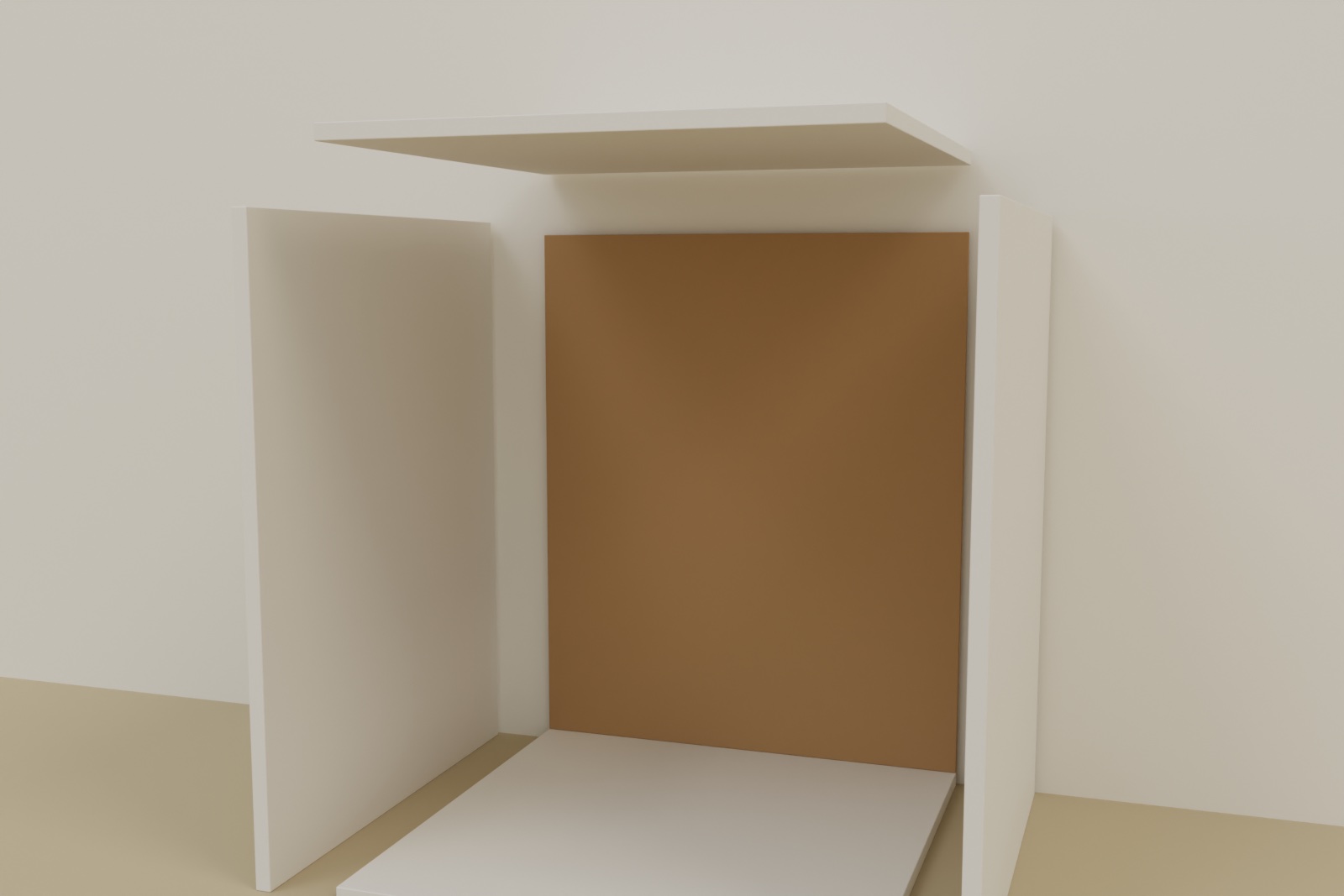
The four structural panels, two sides (gables), a top and a bottom, are all ¾″ (18 mm) board. The odd one out is the back: a thin 5/32″ (4 mm) HDFsheet that only has to square the box and keep dust out, so it doesn't need to be thick. Which board those ¾″ panels are cut from is the whole question below.
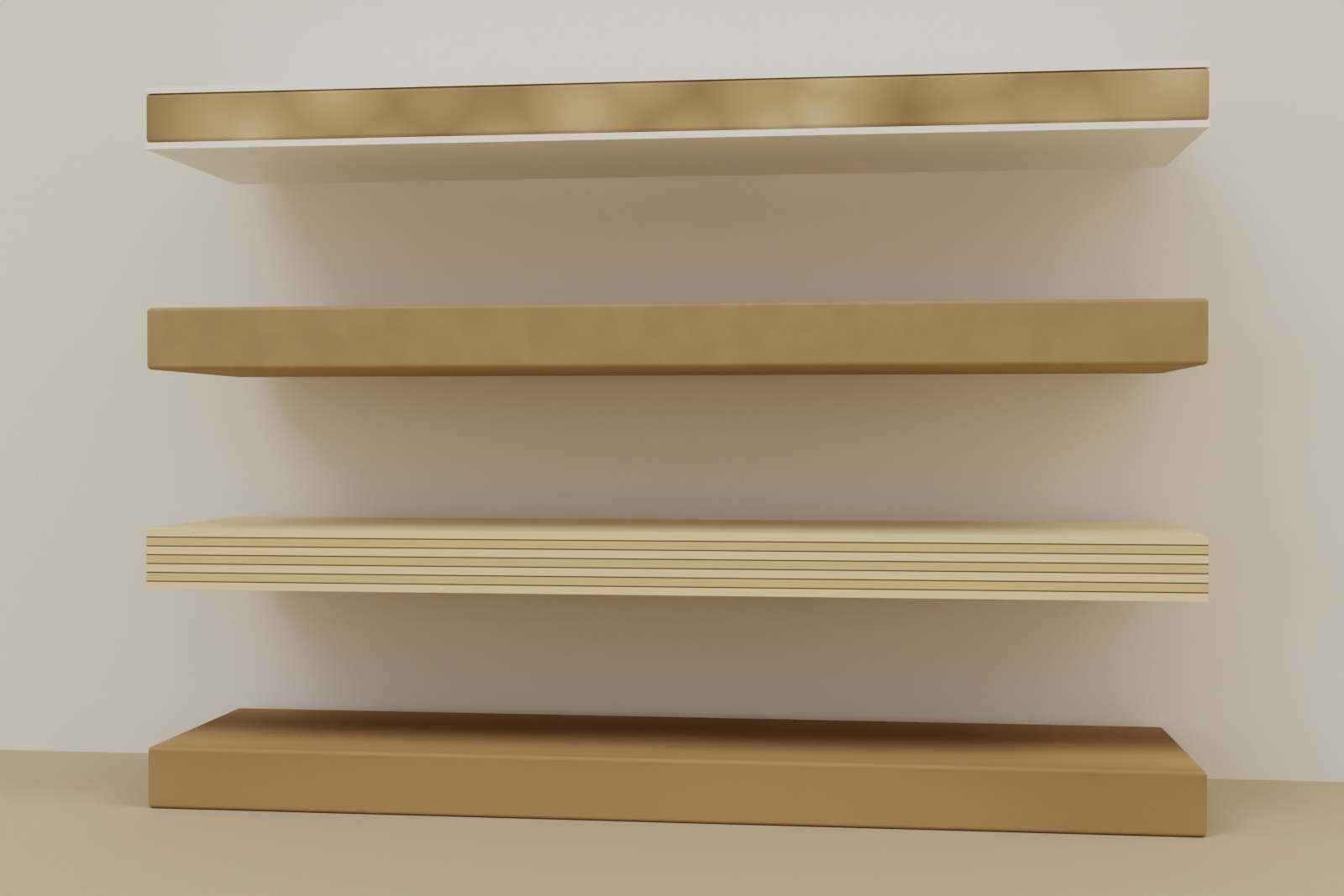
The same ¾″ (18 mm) thickness, four different cores. Top to bottom: MFC (a chip core between melamine skins), MDF (dense and uniform), birch plywood (stacked veneers), and solid wood(growth-ring grain): shown last for contrast, because it isn't a box material.
How each board is made, and what's inside
Every one of these boards starts as wood and ends as a flat sheet. What changes is how finely the wood is broken down and how it's bonded back together, and that's exactly what decides how each behaves in a cabinet.
Chipboard / MFC. Wood is chipped into coarse particles, blended with resin, and hot-pressed into a flat panel, with bigger chips in the core and finer ones near the faces. A decorative melamine-impregnated paperis then fused to both faces under heat and pressure, which is the wipe-clean colour surface you see. The particles and the resin are the whole board, and the cut edge is raw until it's banded, which is why water gets in there and nowhere else.
MDF. Here the wood is broken all the way down to individual fibres, mixed with resin and wax, formed into a thick mat and hot-pressed into a dense, even panel. Because it's fibre rather than chips, there's no grain and no voids, one uniform body, which is why it machines to a crisp edge and paints flawlessly.
HDF. Made like MDF but pressed harder and denserinto a thin, hard sheet (hardboard). That density is why a 5/32″ (4 mm) HDF back is stiff enough to square the box despite being so thin.
Plywood. Thin veneersare peeled from a log and stacked with each layer's grain turned 90° to its neighbour, then glued and hot-pressed. That cross-grain stack, always an odd number of plies, is what makes plywood strong and stable in every direction at once.
Solid wood. Sawn from a log and dried to a working moisture level. Nothing binds it back together, so it keeps moving with the seasons, the reason it stays out of the box and lives in narrow frames instead.
The short lesson: chips, fibres, veneers or planks. Finer and better-bonded means more uniform and stable (MFC, MDF); crossed layers mean strong and stiff (plywood); nothing bonded means it moves (solid wood).
Where each board goes, and how thick
A cabinet is not one material. It is the right board in each spot. Here's exactly what we cut each part from, and the thickness we build in. Boards are stocked in a range of thicknesses; these are the ones that do the job without wasting money or weight.
Part
Board
Thickness
Sides, top, bottom, shelves & partitions
MFC, melamine chipboard
¾" (18 mm)
Drawer sides & backs
MFC, melamine chipboard
¾" (18 mm)
Doors & drawer fronts
MDF, paint-grade
¾" (18 mm)
Back panel & drawer bottoms
HDF, hardboard
5/32" (4 mm)
Upgrade box & long shelves
Birch plywood
¾" (18 mm)
Face-frame rails & shaker frames
Solid wood
varies
MFC: melamine-faced chipboard, the standard box
MFC is chipboard, wood particles pressed with resin into a flat sheet, with a tough melamine layer bonded to both faces. That skin is the finished surface: colour-matched, wipe- clean, no painting needed. Our board is ¾″ (18 mm) Egger White, and it does the most jobs in the cabinet. Its strengths are why it's the industry standard: dimensionally stable (a big flat panel stays flat), cheap and consistent, and finished in the press, with no primer or lacquer on the inside of the box.
Where it's used, and how it does there:
Sides, top, bottom & partitions. Its home turf: flat, stable, faced, cheap. The only real catch is water on a bare edge: an unbanded ¾″ edge wicks moisture and swells permanently, so every cut edge is taped.
Shelves. Fine for normal spans, but ¾″ MFC sags first of the three boards. A long shelf under books or crockery will bow over time. Keep the span short, add a support, or step that shelf up to plywood.
Drawer sides & backs.We build the drawer box from the same ¾″ MFC: sturdy, finished inside, and cheap. The trade is weight: it's a heavier drawer than a thin plywood or steel-sided one.
Screw hold. Good in the face, weaker in the crumbly edge, and it dislikes being re-driven in the same hole, which is why our panels join with face-drilled connectors rather than screws into the edge.
Standard or moisture-resistant. You can have the carcass board two ways: standard MFC, or a moisture-resistant grade (usually a green-tinted core) made with a water-repellent resin. Worth being clear about what that means: it has a better moisture coefficient, so it swells less and slower when it gets damp, but it is not waterproof and nothing like plastic. A soaked or unbanded edge will still fail in the end; the moisture-resistant board buys margin in a splash-prone spot like under a sink or beside a dishwasher. It's a sensible upgrade there, not a licence to skip the edge banding.
MDF: the painter's board
MDFis wood fibre (finer than chipboard's chips) pressed into a dense, completely uniformsheet with no voids and no grain. It's stocked in a wide range of thicknesses, ¼″ to 1″ (6–25 mm), and we use ¾″ (18 mm) where it belongs.
Doors & drawer fronts (its real job). The uniform body mills to a crisp profile and paintsto a flawless, grain-free finish, the reason it's the king of facades. The cons live here too: a ¾″ MDF door is heavy (more load on the hinges), it can dent on a hard knock, and a raw edge is thirsty, so a painted or foiled front seals it.
In the box. Mostly not needed. It's heavier and pricier than chipboard with little structural gain for a plain flat panel, so MFC does the carcass for less. MDF earns a box spot only where a part is shaped or painted rather than laminated.
Plywood: the upgrade board
Plywoodis thin veneers glued in a stack with each layer's grain crossed against the next. That cross-banding is where its strength comes from. We stock a ¾″ (18 mm) birch plywood (Baltic-style, from Riga) as the premium, load-bearing option, and thinner ½″ and ¼″ (12 & 6 mm) for lighter parts. So, are plywood cabinets worth it? It depends on the part:
As the box. Best screw hold (the crossed plies bite hard, face or edge), lighterfor the same panel, and the prestige of an all-plywood carcass. You pay for it: it's the priciest board, in a smaller sheet(about 60 × 60″ / 1525 × 1525 mm) so more offcut, cheap ply hides voids, and the face usually wants veneer or paint.
As a shelf. This is where the upgrade pays off most: plywood is the stiffestboard, so a long shelf holds a line under load where ¾″ MFC would bow.
As a drawer box.A ¾″ or ½″ plywood drawer is stronger and lighter than the MFC default, a genuine premium feel for a heavy kitchen drawer.
So MFC vs plywoodisn't “cheap vs good.” It's a stable, finished, inexpensive board against a stronger, lighter, pricier one. For most parts MFC is enough; plywood is the answer exactly where weight and span demand it.
HDF: the thin one, for back panels and drawer bottoms
HDFis chipboard's denser cousin: hardboard, wood fibre pressed flat and hard. We use it at 5/32″ (4 mm) for the two non-structural panels: the cabinet back and the drawer bottoms. Both sit captured in a groove and carry no load, only keeping the box square and closing it against dust, so thin is correct, not a corner cut. It's cheap, dead flat and hard- wearing; the one rule is don't hang weight on it, because it isn't structural. A thick back would only add cost and weight for nothing.
Solid wood: where it's real, and where it's a myth
“Solid wood cabinets” sells, but it's mostly a misunderstanding. A wide panel of solid timber moves. It cups and cracks as humidity swings, which is precisely what a cabinet side must notdo. That's why the engineered boards above exist: they hold their shape where solid wood won't. Real solid wood earns its keep in the parts that are narrow and can move safely, in whatever thickness the design needs: face-frame rails and stiles, a shaker door'sframe, decorative edges. When an advert says “solid wood cabinets,” it almost always means solid-wood fronts on an engineered-board box, rather than a carcass carved from planks. We don't build solid-wood boxes, and neither should anyone.
This page maps the board to the part. If the question behind it is the shopper's one, whether solid wood beats plywood or chipboard for furniture in general, and which combinations of the three are worth paying for, that comparison has its own page.
The surface: what the front is finished in
The board is the core; the finishis the skin on top, and it's a separate choice, mostly on the doors and drawer fronts, where most of the look (and the cost) lives. On our fronts you can have:
Melamine (MFC). The colour is baked into the board, factory-finished and cheapest. The default, and the same surface that lines the box.
Paint on MDF. Any colour and sheen; the classic shaker or flat painted-kitchen look.
Plastic (acrylic / laminate). A tough plastic skin pressed onto the board for a seamless high-gloss or super-matt front. Scratch- and moisture-tolerant, and common on modern handleless kitchens.
Wood veneer. A thin skin of real woodbonded to the board: genuine timber grain without solid wood's movement. It's an expensive finishing operation, and it's how you get an authentic wood look on a stable, engineered core.
Stone veneer. The exclusive, niche option: paper-thin layer of real stone on a flexible backing, for a stone-look front that a solid slab could never hang as. Specialist and pricey, and genuinely stone.
Which finish suits which door, and the door shapes themselves, is the door styles story. The point here is that the core and the surface are two decisions: a stable board underneath, and the finish you see on top.
The edge
The strip that decides a board's life
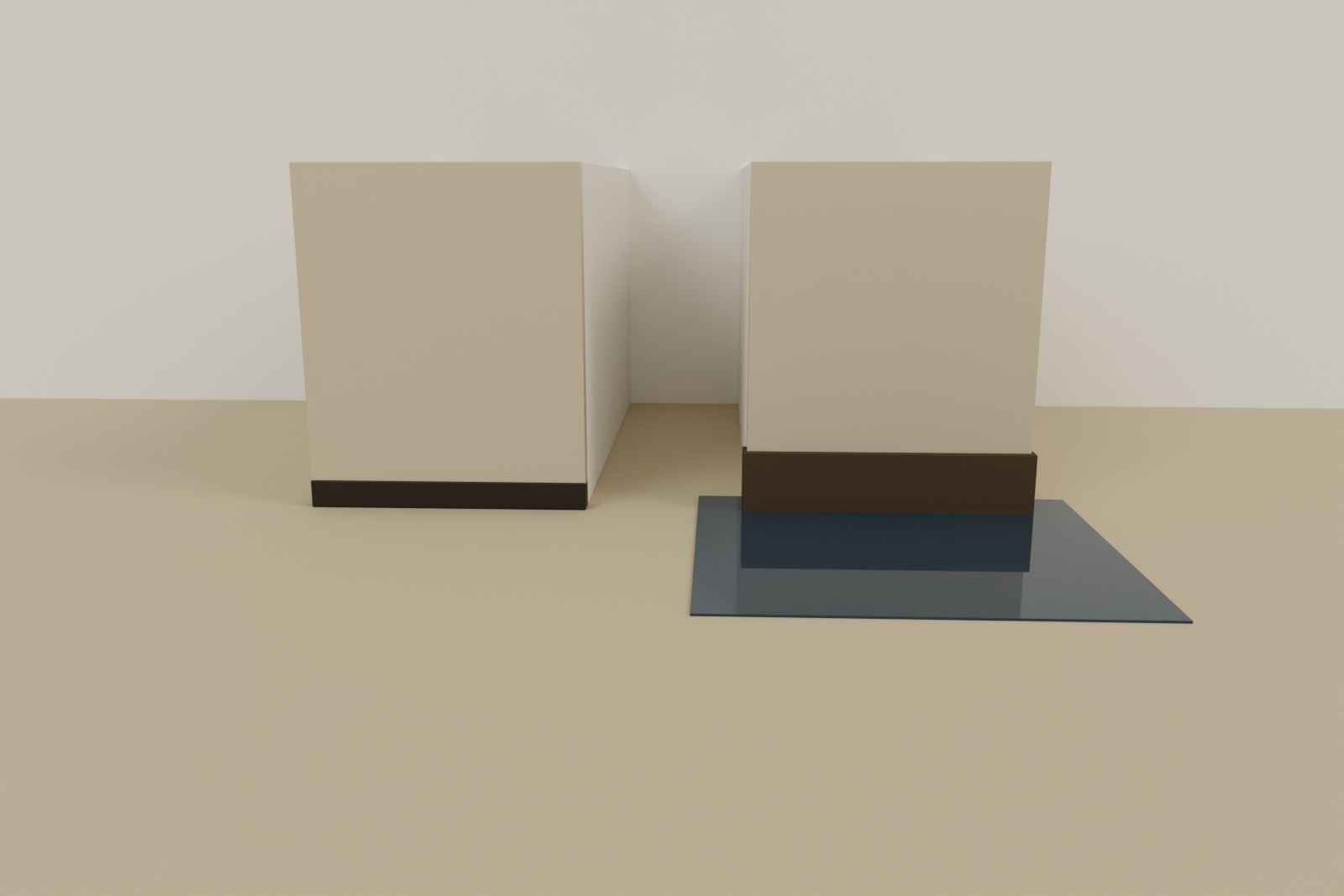
Whatever the board, the edge banding, whether ABS, PVC, melamine or veneer tape, seals every cut edge. Skip it and a bare chipboard or MDF edge drinks water and swells (left banded and safe, right bare and swollen). It's the cheapest insurance on the whole cabinet.
The edge, whatever the board
One choice sits on top of all of them. A cut edge of chipboard or MDF is raw, thirsty core; a strip of edge tape, our default being ABS with PVC, melamine and veneer as options, laminates over it and seals it. Many shops skip banding hidden edges to save a pass on the machine; near water, don't. It's the same reason the bottom edge at the floor matters so much, and it applies to every board here, plywood included. The full story, thin against thick tape, matched against contrasting colour, and when a front is left un-banded on purpose, is in edge banding.
Durability, warping, and making it last
A board decides two different kinds of longevity: whether it holds its shape, and whether it survives water and wear. They're worth separating, because the answers aren't the same.
Warping and cupping. This is the good news about engineered board. MFC, MDF, HDF and plywood are all built specifically not to warp, since chips, fibres and crossed veneers cancel out the movement that makes a solid-timber panel cup and crack with the seasons. The shape-change to watch for is not twist but sag: a long, heavily loaded ¾″ (18 mm) MFC or MDF shelf slowly bows under sustained weight. A mid-support or a step up to plywood fixes it. Solid wood is the outlier that does warp and cup with humidity, the whole reason it never becomes a wide box panel.
Water, wear and how long it lasts. Kept dry and edge-banded, an engineered-board box lasts decades, this is the standard material in millions of kitchens, not a compromise. The failure mode is almost always the same one: water reaching a bare, unbanded edge, where the core swells permanently and can't be undone. So real-world durability is less about which board you pick and more about whether the edges are sealed and the box is kept up off wet floors.
Treatment and finishing. Protecting an engineered board means finishing its faces and its edges. MFC arrives face-finished (the melamine skin); its cut edges are sealed with edge tape in ABS, PVC, melamine or veneer. MDF and plywood need paint, foil or veneer on the faces plus banding on the edges. For the wettest spots, under a sink or next to a dishwasher, moisture-resistant grades of chipboard and MDF exist; whether a given project needs one is worth asking us about.
Extends its life
Band every cut edge, including the hidden ones near water.
Keep the box off the floor and band the bottom edge (legs or a plinth).
Join with face-fix connectors, not screws re-driven into a chipboard edge.
Support or upgrade long, loaded shelves to plywood.
Soft-close hardware and a sound wall: less shock, no sag.
Wipe spills at joints; keep indoor humidity sane.
Cuts it short
Standing water or steam at a bare edge, the number-one killer.
Skipping edge banding to save a pass on the machine.
Overloading a long shelf until it takes a permanent bow.
Stripping a chipboard screw hole by re-driving it.
Hanging a heavy cabinet on weak fixings or a hollow wall.
MFC (chipboard)
MDF
Plywood
Thickness we use
¾" (18 mm) for the box; comes in ⅝"–¾" (16–18 mm).
¾" (18 mm) for fronts; stocked ¼"–1" (6–25 mm).
¾" (18 mm); also ½" and ¼" (12 & 6 mm) for lighter parts.
Screw hold
Good in the face, weaker in the edge, since the chip core crumbles if you overdrive or re-drive a screw.
Even all through, but softer than ply; edge screws need care.
Best. The crossed veneers grip a screw hard, in the face and the edge.
Water
Fine sealed; a bare edge drinks water and swells for good. Band the edges.
Same story: dense but thirsty on a raw edge, and it swells if it gets wet.
Most forgiving of the three, but a raw edge still needs sealing.
Weight
Heavy.
Heaviest of the three.
Lightest for the same panel.
Stiffness (sag over a span)
Sags first. A long loaded shelf will bow, so keep spans short or support them.
Also sags under load over a span; heavy for its stiffness.
Stiffest, and the reason to upgrade long shelves and wide boxes.
Stays flat (warp / cup)
Excellent. Engineered not to twist or cup, and it holds its shape.
Excellent: uniform and dimensionally stable, with no grain to move.
Excellent. Crossed plies cancel movement, though cheap ply can face-check.
Lifespan
Decades kept dry; the one killer is water at a bare edge.
Decades if sealed and painted; edges and dents are the weak points.
Longest-lived box; forgiving of knocks and damp, still needs sealing.
Cost
Cheapest, and the reason it's the industry standard box.
More than chipboard.
The priciest board, and it comes in a smaller sheet, so more offcut.
Surface
Finished in the press: a colour-matched melamine face, ready to use.
Smooth and blank; wants paint or foil (which is why it rules facades).
A real wood face with the odd patch/void; often veneered or painted.
Where it fits
The default box, shelves, partitions and drawer boxes.
Doors and drawer fronts; occasionally a box part where mass is fine.
A premium or load-bearing box: long shelves, heavy pulls, all-ply builds.
So which should you pick?
MFC (melamine chipboard), ¾″ (18 mm), the right default for the box, shelves, partitions and drawer boxes: stable, finished, affordable, and completely enough for a normal kitchen as long as the edges are banded.
Plywood, ¾″ (18 mm), the upgrade where it earns it: long shelves that mustn't bow, heavy doors and pulls, or an all-plywood box you'll pay for.
MDF, ¾″ (18 mm), the board for doors and drawer fronts and painted parts, not the plain carcass.
HDF, 5/32″ (4 mm), the back panel and drawer bottoms, thin because they carry no load.
Solid wood, for face frames, shaker frames and edges, never the box panels.
The quick version, by situation
Standard kitchen, sensible budget, or a rental.MFC throughout. It's what most of the market ships, and it's completely fine kept dry and banded.
Long open shelves or a loaded pantry. Plywood shelves, so they hold a line instead of bowing.
Heavy drawers (a stone-top kitchen, big pans): plywood drawer boxes for strength with less weight.
Painted or shaker fronts. MDF doors and drawer fronts; the box underneath stays MFC.
Wet spots(under the sink, by the dishwasher): board matters less than keeping the box off the floor and banding every edge; ask us about a moisture-resistant grade if it's a real soaker.
You don't have to settle this on a spec sheet. Build the cabinet in the editor, and every part, box, shelves, back and edges, is priced to the millimetre, so you can see what the material choice costs on your design and weigh it against what cabinets cost overall.
Why it pays to ask what it's made of
Two cabinets can look identical in a showroom and be built completely differently. “Chipboard” or “MDF” isn't a single thing: the same name covers boards from different manufacturers that vary a lot in density, surface toughness, how flat they stay and the quality of the resin holding them together. A budget board and a premium one can wear the same label. So when you compare quotes, ask the plain question: which board, and whose.
The material is one of the biggest levers on a cabinet after its size, it moves cost, durability and price together. Three things drive that, and only one of them is visible on a spec sheet:
Which board, and which maker. A denser, better-faced board costs more and lasts longer; a cheap one saves money now and shows it later. Same name, different cabinet.
How much material is used. Price tracks the board that goes in: a full-thickness back instead of a thin one, more shelves, deeper boxes all add material, cost and, usually, sturdiness. Less board is cheaper, and sometimes flimsier.
Whether the process is respected. The classic corner to cut is edge banding: sealing every cut edge of MFC is what keeps moisture out of the core, so skipping it on hidden edges is cheaper to build and quicker to fail. A suspiciously low quote has often saved exactly here.
On our side, the board and the banding are only part of it, since we also detail the constructionso parts don't sit against wet zones where we can avoid it: the box kept up off the floor on legs or a plinth, edges sealed where water lives, joints kept out of the splash. The board matters; so does how it's put together around the water.
Build it and price the box
Draw your cabinet, and the carcass, shelves, the HDF back and every banded edge are counted and priced to the millimetre, so the material choice is a number rather than a guess.
The box (carcass) of most kitchen cabinets is ¾" (18 mm) melamine-faced chipboard, MFC, which is particleboard with a wipe-clean melamine surface pressed on. It's stable, affordable and finished out of the press. The same board makes the shelves, partitions and drawer boxes. The back and drawer bottoms are a thin 5/32" (4 mm) HDF. Doors and drawer fronts are usually ¾" (18 mm) MDF for a painted finish. So a cabinet is really made of two or three materials, each doing its own job.
How thick are cabinet panels?
The structural panels, sides, top, bottom, shelves and partitions, are ¾" (18 mm), and so are MDF doors and drawer fronts. The back panel and drawer bottoms are a thin 5/32" (4 mm) HDF because they carry no load. Boards come in other thicknesses (MDF is stocked from ¼" to 1" / 6–25 mm, plywood in ¼", ½" and ¾" / 6, 12, 18 mm), but ¾" for structure and 5/32" for backs is the standard that does the job without wasting weight or money.
Is chipboard (particle board) cheap or low quality?
Chipboard gets a bad name, but MFC is the standard box material across most of the cabinet industry, premium European brands included. Kept dry and properly edge-banded it lasts for decades. Its one real weakness is water reaching a bare, unbanded edge, which swells the core for good. 'Cheap' here is about price, not lifespan: you're paying for a stable, pre-finished board, not a corner cut. Plywood is an upgrade for weight and span, not a rescue from a bad material.
Do cabinets warp or sag over time?
Engineered boards, MFC, MDF, HDF and plywood, are built specifically not to warp or cup, so a properly made box holds its shape; that's the main reason they replaced solid wood for wide panels. The change to watch is sag, not warp: a long, heavily loaded ¾" (18 mm) chipboard or MDF shelf can slowly bow. The fix is a mid-support or stepping that shelf up to plywood, which is the stiffest of the boards. Solid wood is the one material that does warp with humidity, which is why it stays in narrow frames.
Why do two same-size cabinets cost so differently?
Because the material and the making aren't visible in a photo. The same 'chipboard' or 'MDF' comes from different manufacturers at very different densities and quality, so one board costs and lasts more than another under the same name. Price also tracks how much material goes in (a full-thickness back, more shelves, deeper boxes) and whether the process is respected, above all edge banding, which seals the core against moisture. A cheaper quote has usually saved on the board grade, the amount of it, or the banding. It's worth asking which board, whose, and whether every edge is sealed.
Do you offer moisture-resistant board, and is it waterproof?
Yes. You can have the carcass in standard MFC or a moisture-resistant grade (usually a green-tinted core) made with a water-repellent resin. It has a better moisture coefficient, so it swells less and slower when damp, which makes it a sensible upgrade under a sink or beside a dishwasher. But it is not waterproof and nothing like plastic: a soaked or unbanded edge still fails eventually, it just buys margin. It's an improvement, not a licence to skip edge banding.
Is plywood better than chipboard (MFC) for cabinets?
It depends on the part. Plywood holds screws harder, weighs less and is stiffer, so it's the better choice for long shelves that would otherwise bow, heavy doors, or an all-plywood box, and it costs more, comes in a smaller sheet, and still needs its edges banded. Chipboard (MFC) is more dimensionally stable, comes finished, and is much cheaper. For most parts MFC is enough; plywood is a worthwhile upgrade exactly where weight and span demand it.
What's the difference between MDF and plywood for cabinets?
MDF is dense, uniform wood fibre with no grain or voids. It mills and paints beautifully, which makes it the top choice for doors and drawer fronts, but in a box it's heavy and adds cost without much structural gain. Plywood is stacked cross-grain veneers: lighter, stiffer and far better at holding screws, so it's the structural upgrade for the box, shelves and drawers. Both are typically ¾" (18 mm), both need their cut edges sealed, and both cost more than plain chipboard.
Are solid wood cabinets real?
Mostly not in the way the phrase implies. A wide solid-wood panel cups and cracks as humidity changes, so it makes a poor cabinet box, which is the whole reason engineered boards like MFC and plywood exist. Solid wood does belong in the narrow parts that can move safely: face-frame rails, shaker door frames and edges. 'Solid wood cabinets' in an advert almost always means solid-wood fronts on an engineered-board box.
Why is the back of a cabinet so thin?
The back panel is a thin 5/32" (4 mm) HDF sheet because it carries no load. It keeps the box square and closes it against dust, captured in a groove. All the structure is in the ¾" (18 mm) sides, top and bottom. A thick back would only add weight and cost for no benefit, so thin is the correct choice rather than a corner cut. The same 4 mm sheet is used for drawer bottoms.