Cabinet hinges: types, angles, and how many a door needs
You touch the hinges more than any other part of a cabinet and look at them less. They decide whether the door closes itself or slams, how far it swings out of your way, whether you can pull a drawer out from behind it, and on a tall heavy door, whether the gaps still line up in five years. This page covers what a modern concealed hinge is, what the opening angle buys you, how many hinges go on a door of a given height, and where the real limits sit. Door sizes read in inches with millimetres in brackets; the boring reads in millimetres, because that is how the hardware and the machine both take it.
Every hinge we fit is a concealed European clip-on: the kind that lives inside the cabinet, sits in a Ø35 mm cup bored into the back of the door, and adjusts in three directions with a screwdriver after the door is hung. The standard one opens 110°, enough for a door to stand clear of its own opening. A wide-angle 155° version exists for doors that have to get further out of the way. Soft-close is a damper built into the hinge, and in daily use it is the most noticeable thing about the hardware. How many you need follows door height rather than taste: two up to about 35½" (900 mm), three to 75" (1900 mm), four to 94½" (2400 mm), five above that. The thing that goes wrong in service is rarely the hinge failing. A wide, heavy door works its cups loose in the board.
What a modern cabinet hinge is
If your idea of a hinge is a butt hinge, two leaves and a pin screwed to the edge of the door and visible from outside, nothing on this page looks like that. A concealed hinge, also called a European hinge or a cup hinge, has two halves:
The cup and arm, sunk into a round pocket bored into the back of the door and held by two screws. From the front of a closed cabinet you see nothing at all.
The mounting plate, screwed to the inside face of the cabinet side. The arm clips onto it, hence clip-on. You can lift a door off its plates in a couple of seconds and put it back exactly where it was, which is how a kitchen gets painted, or a worktop gets fitted, without unscrewing anything.
Between the two sits a four-bar linkage, and it explains the shape of the swing. The door does not turn about its own hinged edge the way a room door turns on its pin. The instantaneous axis sits slightly outside the cabinet, so as the door opens it first lifts over the corner of the cabinet side and only then swings clear. That is what lets a door sit flush against a neighbour with a 2–3 mm gap and still open without grinding into it. Our 3D preview swings the door about that same point, so what you see on screen is the arc you get in the room.
The last piece is adjustment. Every hinge here moves in three directions after the door is on: side to side, in and out, and up and down. A fitted kitchen has even gaps and a flat-pack one often does not, and this is the reason. Nobody builds those gaps. Someone dials them in at the end.
Soft-close: the part you feel
A soft-close hinge carries a small damper in its arm. Over the last few degrees of travel it takes the door out of your hand and closes it for you, slowly and silently, however hard you pushed. Blum call theirs BLUMOTION, Hettich call theirs Silent System. Three of the four hinges in our catalogue have one.
The fourth, a plain clip-on opening 100°, does not, and it is the most instructive thing in the list. Same cup, same plate, same three-way adjustment. Only the damper is missing. The door shuts with a bang, bounces if you are careless, and announces to the room what kind of cabinet it is. Runners tell the same story, as the guide to them covers: the carcass is identical, and the hardware is what you feel.
One note about where dampers belong. On a very small or very light door, an integrated damper can be strong enough that the last inch feels reluctant, and some hinges ship with the damping switched off for doors below about 12" (300 mm) wide. That is a fitting detail rather than a design decision, and it explains why a tiny door sometimes feels different from its neighbours.
Opening angle: 110° against 155°
The angle quoted on a hinge is how far the door swings before the linkage runs out. 110° is the standard, and it covers the ordinary job: the door passes square to the cabinet and keeps going a little, so the opening is clear and you can reach the back of a shelf without the door in your way.
155°, a wide-angle hinge, buys you the range past square. Three situations need it:
Something has to come out through the opening. A pull-out larder, a waste unit, or drawers fitted behind a door. At 110° the door edge still sits in the path of the drawer as it comes forward. At 155° it lies flat back against the run.
Corner cabinets. A door in a corner has to open further to clear the return, or it fouls the adjacent cabinet.
A door that would otherwise hit something, whether a wall, a tall unit or an appliance handle. The wide-angle version gets it out of the way instead of parking it in the traffic.
Everywhere else, 110° is the right answer, and the wide-angle costs noticeably more than the standard hinge for range you never use.
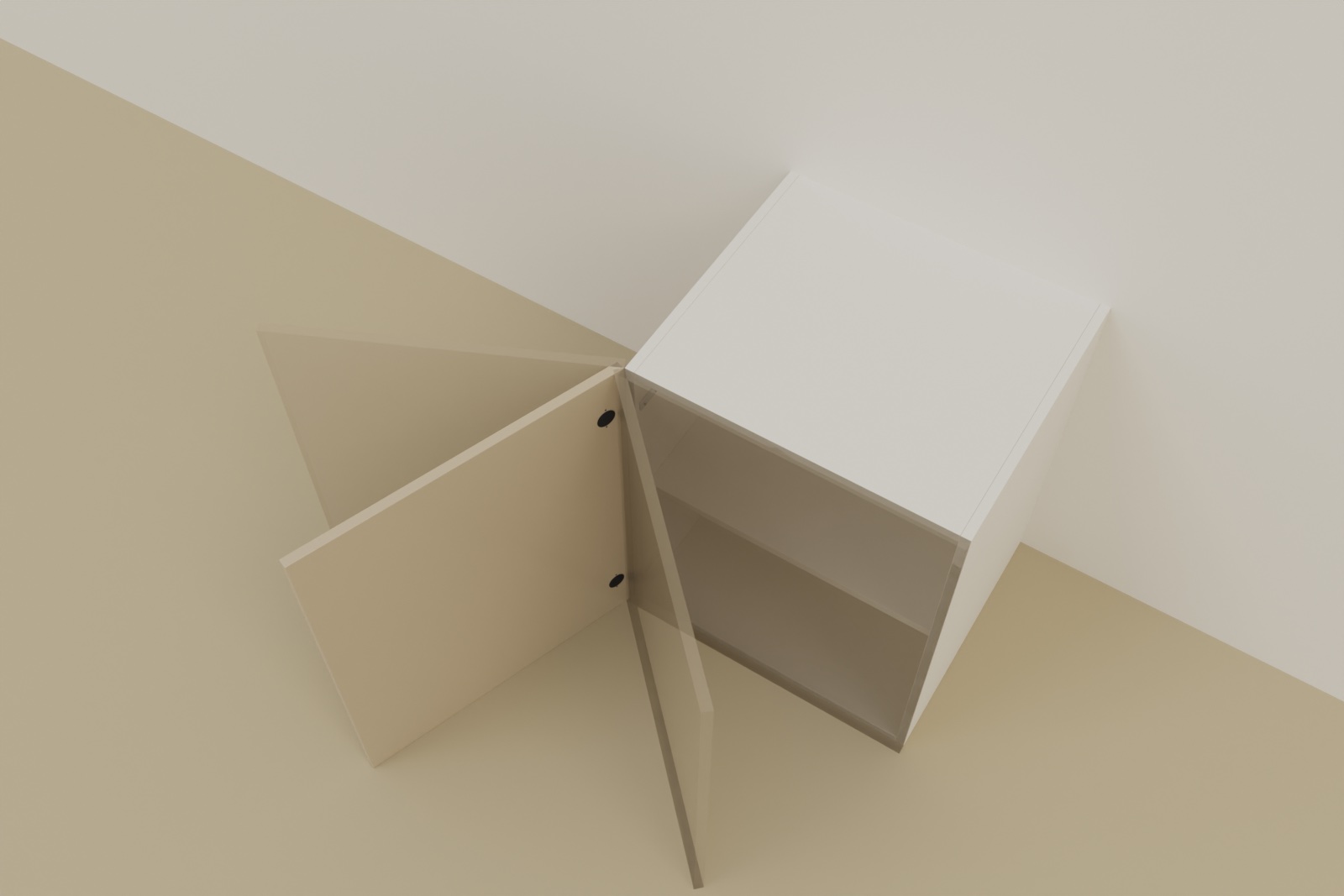
One door, four positions, one pivot: closed, 45°, the solid one at 110° (our default hinge), and the 155°wide-angle swung right back out of the way. Seen from above, because that is the only view where the swing reads as an arc. The pivot is not the door's own edge. It sits on the outer front corner of the cabinet side, which is how the door lifts over that corner instead of into it.
How many hinges a door needs
Door height decides this, not judgement, and our editor applies the rule for you as you resize a cabinet. Two hinges hold a normal door. Each extra one shares the load and stops a long door bowing between its fixings.
Door height
In inches
Hinges
Typically
up to 900 mm
up to about 35½"
2
A base-unit door, a wall-unit door, most single doors
901–1900 mm
about 35½–75"
3
A tall wall unit, a half-height larder door, a wardrobe door
1901–2400 mm
about 75–94½"
4
A full-height pantry or utility door
above 2400 mm
above about 94½"
5
Floor-to-ceiling doors in a tall run
Where they go matters as much as how many. The outermost hinges sit 4" (100 mm) in from each end of the door, far enough from the corner to have sound board around the cup and close enough to the end to hold it flat. Any hinges beyond those two spread evenly between them. On a very short door the end setback shrinks to a quarter of the height, so a small door does not end up with both cups nearly touching.
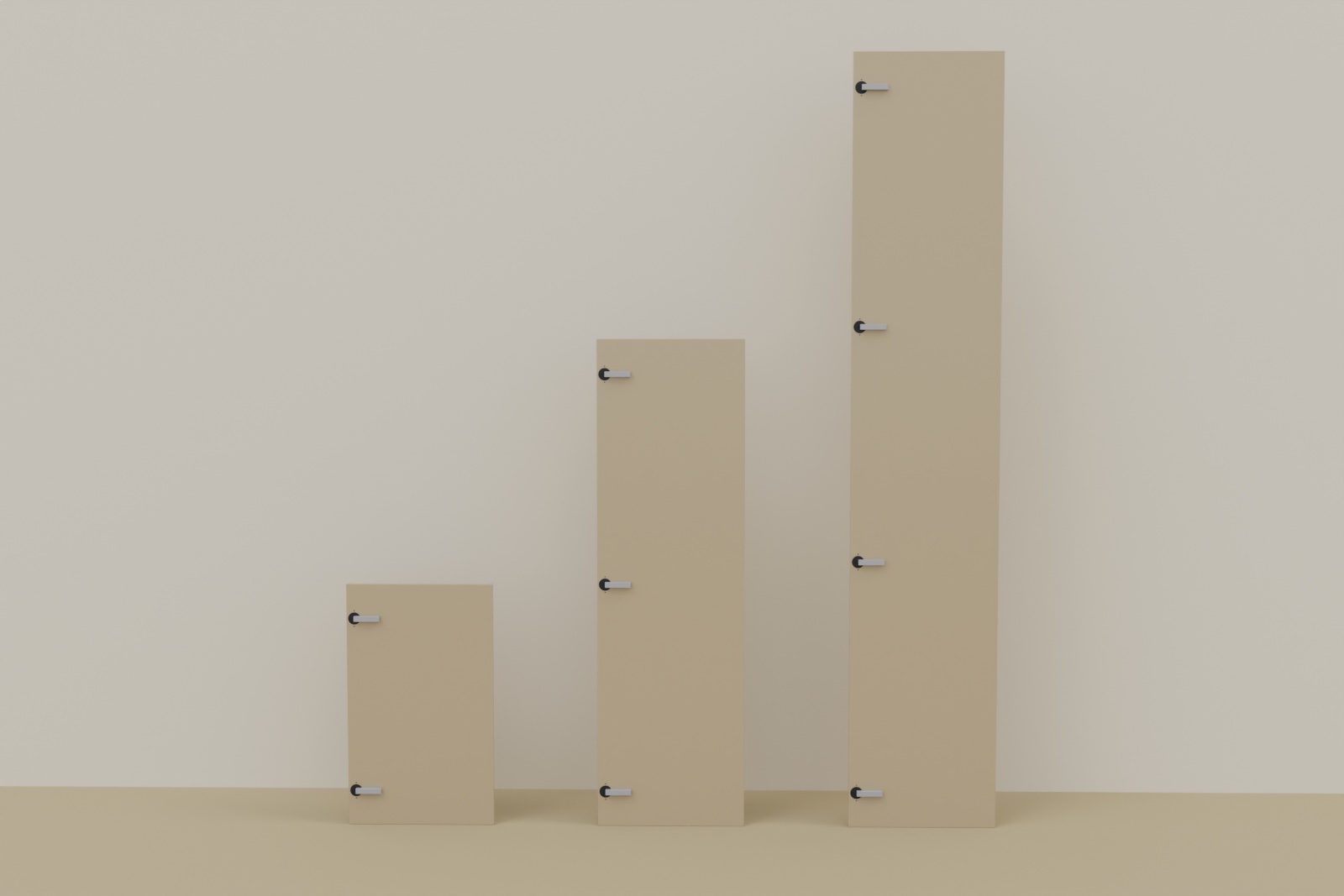
The rule made visible: same door width, three heights of 27½" (700 mm), 55" (1400 mm) and 86½" (2200 mm), taking two, three and fourhinges. The top and bottom hinges hold the same 4" (100 mm) setback in all three; only the ones in between move. Shown as bare doors, backs out, because a carcass would put a cabinet side in front of every cup.
Weight, width and sag
Hinges rarely break. What people describe as a hinge failing is almost always one of two things, and both come down to leverage.
A door hangs off one edge, so the top hinge resists a turning moment: roughly the door's weight multiplied by how far its centre sits from the hinge line. Width hurts more than height. A tall narrow door is an easy load. A wide door of the same weight pulls far harder on the same hinge, because every pound of it sits further out. Add real weight, whether thick MDF, a milled or raised panel, glass or a mirror, and the two multiply.
What that looks like in a kitchen:
The door drops at the outer edge. The gap at the top of the free side opens and the bottom closes up. Reach for the adjustment screws first. If it comes back after a few months, the fixings are moving.
The cup works loose in the board. This is the real failure. The cup screws hold in chipboard by friction, and a heavy wide door cycles them thousands of times. Once a cup starts to move, the door sags however you adjust it, and the repair means plugging and re-drilling the hole.
The fixes are dull, and they work, in this order:
Add hinges. The cheapest and most effective move. Each one takes a share of the load, and the rule above is a floor rather than a ceiling. A heavy door justifies one more than the height alone calls for.
Keep doors narrow. Two doors on a wide opening instead of one is a structural decision as much as a visual one, and it is why a wide cabinet almost always gets a pair.
Match the hinge to the door. Makers publish door-weight charts against width for each of their hinge families, including heavy-duty lines for glass and thick fronts. If you are designing something unusually large or heavy, build to that chart rather than to a rule of thumb.
We do not print a table of kilograms here. A safe working load depends on the hinge family, the number fitted, the door width and what the cups are screwed into, and a single reassuring number for all of that would be wrong in the cases that matter. If your door is large, heavy or glass, ask us rather than trusting a round figure.
Overlay, half-overlay, inset: the plate does the work
One thing confuses people shopping for hinges. The same hinge covers several kinds of door fit, and what changes is the mounting plate, specifically how far it stands the door off the cabinet side.
Full overlay, where the door sits on the front edge of the cabinet side and covers it. The default in frameless cabinets.
Half overlay, where two doors share one cabinet side between them, each covering half of its edge.
Inset, where the door sits inside the opening, flush with the front edges, with an even reveal all round. A different plate again, and much less forgiving: the gaps show on all four sides, so the adjustment matters more.
Which of those you want is a design decision with real cost and maintenance consequences, and it has its own guide in inset vs overlay cabinet doors. The hinge stays in the same family for all three.
The boring: Ø35 and the 32 mm grid
Concealed hinges are interchangeable across makers for one reason. They all agree on the holes. The cup is a 35 mm bit, the cabinet side is drilled on the 32 mm System-32 grid that also carries shelf pins and drawer runners, and the numbers below are what our machine cuts.
Dimension
Value
Why it is that
Cup diameter
Ø35 mm (1⅜")
One bit, every concealed hinge on the market. That is why they are interchangeable.
Cup depth
11.5 mm (7⁄16")
Into an 18 mm (¾") door. Deep, but not through it.
Cup centre from the door edge
22.5 mm (⅞")
Fixed by the overlay the hinge is set up for. Move it and the door sits in the wrong place.
Between the two cup screws
45 mm (1¾")
Along the length of the door, one above the cup and one below.
Plate screws on the gable
32 mm (1¼") apart
System 32, the same grid the shelf pins and the drawer runners are drilled on.
Plate centre from the cabinet front
37 mm (1½")
Sets how far the door stands off the carcass edge.
We drill all of this before anything is packed, on the same run as the panels themselves. It is also why the 2D drawing has a Holes layer: the boring belongs to the drawing, not to a jig on site.
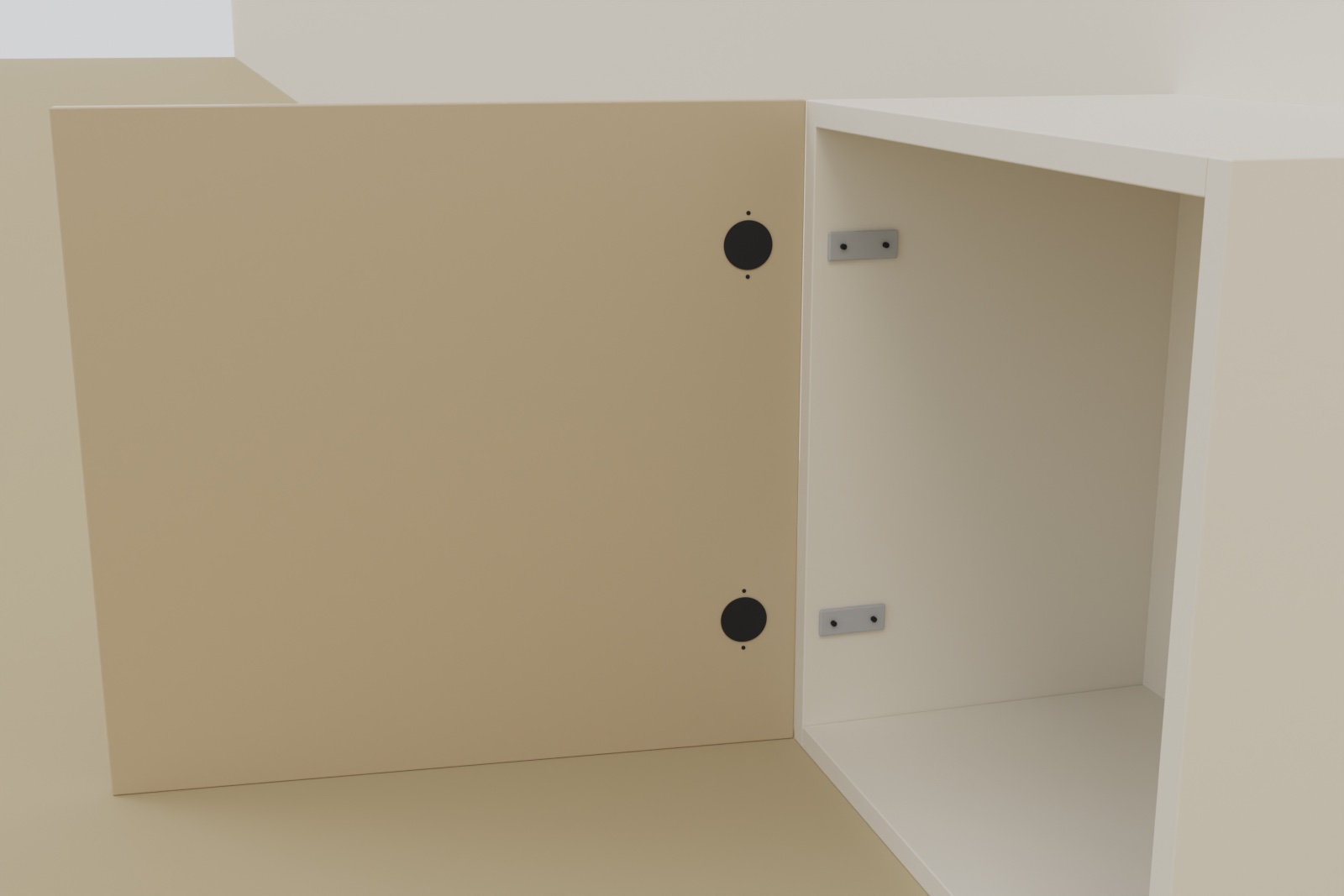
The two halves, opened out. On the door: the Ø35 mm cup, 11.5 mm deep, its centre 22.5 mm in from the hinged edge, with a screw 22.5 mm above and below it. On the cabinet side: the plate, its two screws 32 mm apart on the System-32 row, centred 37 mm back from the front edge. Every number here is the one the machine cuts.
The four we fit
Concealed clip-ons, all of them, on the same Ø35 cup and the same System-32 plate row. Switching between them changes the feel and the swing, never the drilling.
Blum CLIP top BLUMOTION 110°
Blum CLIP top BLUMOTION 155°
Hettich Sensys 110°
Generic clip-on 100°
Maker
Blum
Blum
Hettich
Generic
Opening angle
110°
155°
110°
100°
Soft-close
Yes
Yes
Yes
No
Damper
BLUMOTION, integrated in the hinge arm
BLUMOTION, integrated in the hinge arm
Silent System, integrated
None. The door closes as hard as you push it
Where it belongs
The default on everything we build. The angle a normal door wants, with the damper you notice every day
Where the door has to get out of the way: pull-outs and inner drawers behind a door, corner cabinets, a door that would foul a wall or a run
The same job as the Blum 110°, from the other big European house. Specify it if the rest of the room is Hettich
Where nobody stands: a utility cupboard, a plant-room door, a back-of-house carcass. The only hinge here without a damper, and you feel that at once
So which one
Almost everything takes the standard 110° soft-close. The angle covers the ordinary job and the damper is the part you notice every day.
Doors with pull-outs or inner drawers behind them, corner cabinets and anything that fouls take the 155° wide-angle. Buy the range where you need the range.
The undamped clip-on belongs back of house. It saves a little on a cupboard nobody stands in front of. Put it in a kitchen and you have made the one saving your guests can hear.
On big, wide or heavy doors, add a hinge before you argue about brands. The count carries the load. The badge on the arm is a distant second.
Change the door, watch the hinges follow
Hinge count is not a line you fill in. It comes off the door height, and the boring comes off the hinge. Resize a door in the editor and the hinges are re-counted and re-spaced, the cups and plates move with them, and the drawing that reaches the machine updates with it.
Concealed European hinges, also called cup or clip-on hinges. The hinge sits in a 35 mm round pocket bored into the back of the door and clips onto a plate screwed to the inside of the cabinet side, so nothing shows from outside when the door is shut. They adjust in three directions, side to side, in and out, up and down, after the door is hung, which is how gaps are made even, and the door can be unclipped from its plates and put back in the same position in seconds. Older-style butt or surface hinges are still made, but essentially every frameless cabinet built today uses concealed hinges.
How many hinges does a cabinet door need?
Door height decides it. Up to about 35½ inches (900 mm) a door takes two hinges; up to 75 inches (1900 mm) it takes three; up to 94½ inches (2400 mm) four; and taller than that, five. The outermost hinges sit about 4 inches (100 mm) in from each end and any others spread evenly between them. Treat that as a minimum rather than a limit: a door that is unusually wide, thick, glazed or otherwise heavy justifies one more than the height alone calls for, since each additional hinge takes a share of the load.
What is the difference between a 110 and a 155 degree hinge?
The number is how far the door swings before the linkage runs out. At 110 degrees, the standard, the door passes square to the cabinet and keeps going a little, which clears the opening for normal use. A 155-degree wide-angle hinge takes the door much further back, and three cases need that: when something has to come out through the opening, such as a pull-out larder or drawers fitted behind a door; in corner cabinets, where the door must clear the return; and where the door would otherwise foul a wall, a tall unit or an appliance. Everywhere else the wide-angle costs more for range you never use.
What does a soft-close hinge do?
It carries a damper in the hinge arm that catches the door over the last few degrees of travel and closes it slowly and silently, however hard you pushed. Blum call theirs BLUMOTION and Hettich call theirs Silent System. The mechanical difference from an undamped hinge is tiny, since the cup, the plate and the adjustment are identical, but in daily use it is the most noticeable thing about cabinet hardware. Three of the four hinges in our catalogue have one and the fourth is reserved for cupboards nobody stands in front of. On very small or light doors an integrated damper can feel over-strong, and some hinges ship with damping switched off for that reason.
Why is my cabinet door sagging?
Leverage, in almost every case, rather than a broken hinge. A door hangs off one edge, so the top hinge resists a turning moment of roughly the door's weight times how far its centre sits from the hinge line, which means width hurts more than height. A wide door pulls far harder than a tall narrow one of the same weight. Try the adjustment screws first, since that is what they are for. If the sag returns after a few months, the cups are working loose in the board: the cup screws hold in chipboard by friction, and a heavy wide door cycles them thousands of times. That repair means plugging and re-drilling. Prevention is more hinges, narrower doors, two on a wide opening rather than one, and a hinge family rated for the door you are hanging.
How much weight can a cabinet hinge hold?
There is no single honest number, which is why we do not publish one. A safe working load depends on the hinge family, how many are fitted, how wide the door is and what the cups are screwed into, and a wide door loads a hinge far harder than a narrow one of the same weight. Manufacturers publish door-weight charts plotted against door width for each of their hinge lines, including heavy-duty versions for glass and thick fronts, and an unusual door should be built to that chart. As a practical matter, adding a hinge is the cheapest way to buy margin, since each one takes a share of the load.
Are cabinet hinges interchangeable between brands?
In the boring, yes, which is the point of the European system. The cup is a 35 mm bore in every case, the cup screws sit a fixed distance apart, and the plate lands on the 32 mm System-32 grid that also carries shelf pins and drawer runners. So a Blum and a Hettich hinge of the same overlay and angle drop into the same holes. Arm and plate are not interchangeable between makers, since you clip a maker's arm onto that maker's plate, and the angle and damping differ too. Swapping brands on an existing cabinet usually means changing both halves rather than just the arm.
What is the hole size for a concealed cabinet hinge?
35 mm in diameter, one bit, universally. In our cabinets it is bored 11.5 mm deep into an 18 mm (¾ inch) door, with the centre of the cup 22.5 mm in from the door's hinged edge, and a screw 22.5 mm above and below the cup centre. On the cabinet side the mounting plate is fixed by two screws 32 mm apart along the System-32 row, centred 37 mm back from the front edge. All of it is drilled before the parts are packed, and it appears on the Holes layer of the drawing rather than being worked out on site with a jig.
Do overlay and inset doors use different hinges?
They use the same hinge family with a different mounting plate. The plate sets how far the door stands off the cabinet side, which turns the same hinge into a full-overlay fitting where the door covers the edge of the cabinet side, a half-overlay one where two doors share a single side between them, or an inset one where the door sits inside the opening flush with the front edges. Inset is the least forgiving of the three, because the reveal shows on all four sides, so the three-way adjustment matters a great deal more.